
Senpi AI analyzed 381,262 Hyperliquid app wallets: cut builder fees 50% and 8,400 traders turn profitable
381,262 Hyperliquid wallets on six retail apps: what builder fees cost traders, and how many turn profitable when the fee is cut.
Originally published on X on October 21, 2026. Read the original on X.
@HansonBirringer at Hyperdash published this great report last week: 400,000 traders came to Hyperliquid through six retail apps, and they are down $280M.
>> Over half of what they lost through the apps went to fees.
>> One in seven is still trading after three months.
That piece asked who these traders are and how they have done.
This article asks the next question:
What happens to those same traders if the apps charge them less builder fees?
Hyperliquid publishes every fill that carries a builder code, so the answer can be computed rather than argued.
@senpi_ai re-ran the six apps' full histories, 381,262 wallets and $67.5bn of trades, then pulled every fill, liquidations included, for an 1,800-wallet sample to get each trader's real outcome. Then it re-priced the same trades at a lower builder fee and counted who ends up net profitable.
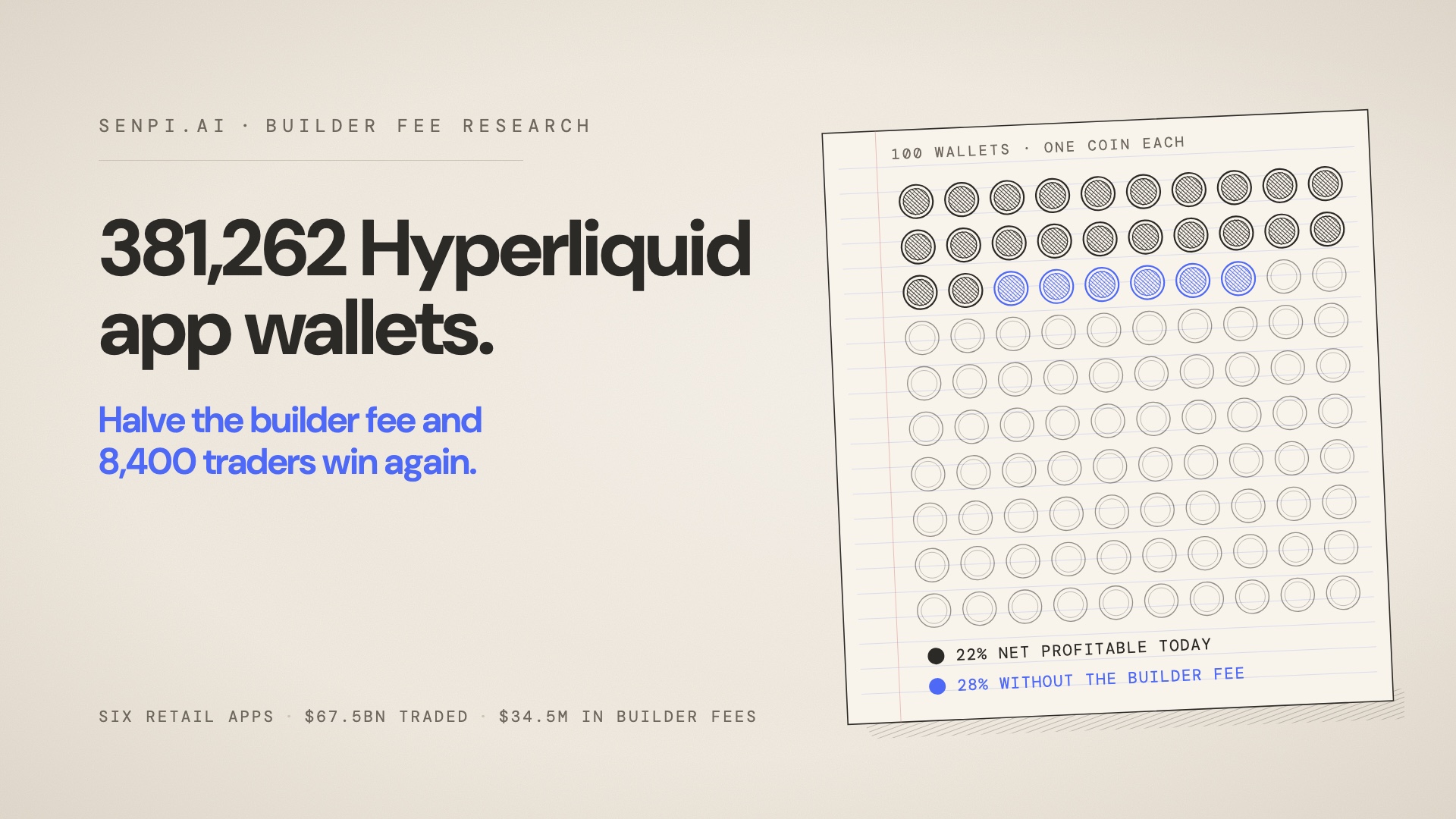
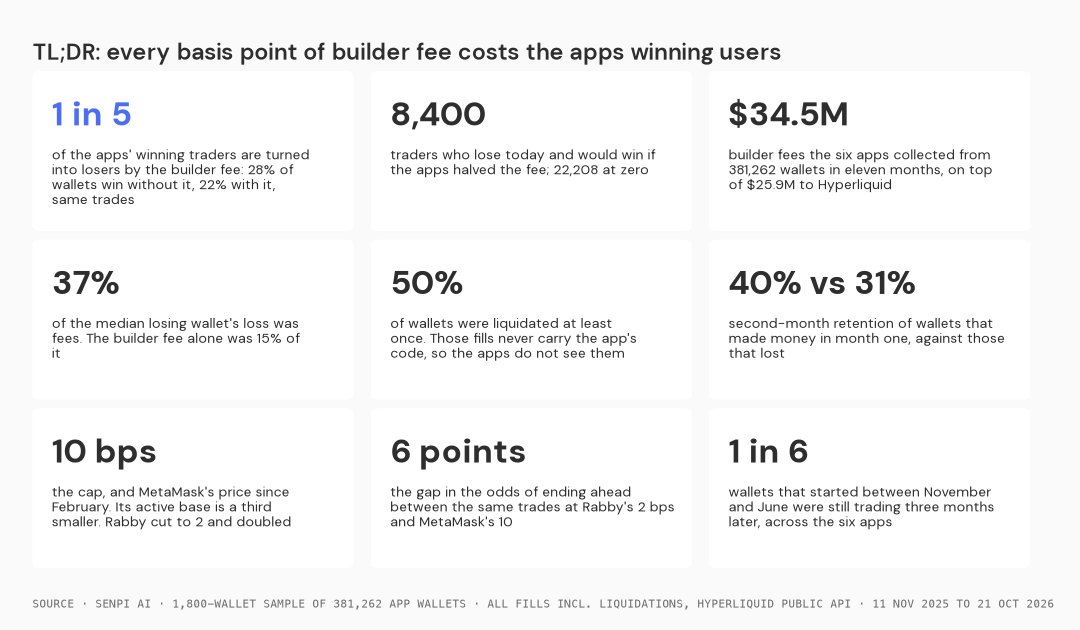
The one claim: the builder fee is a tax on turnover, and it falls hardest on the users who are already losing. At the fees the apps charge today, 22% of their wallets are net profitable. Without the builder fee, and with nothing else about the trades changed, 28% would be.
The builder fee turns one in five of the apps' winning traders into losing ones, one in four at Phantom. Cut the fees by 50% and 8,400 traders who lose today win again. The apps collected $34.5M from those wallets in eleven months to keep it that way, and half of each month's traders are new because the other half did not come back.
There is a reason the smartest money is not in this dataset.
In a piece earlier today, Senpi is building Cursor for Trading, we counted the other side: on Hyperliquid, traders with no third-party app in the loop do 84% of the non-market-maker volume, and app usage falls as accounts get bigger, from nearly half of the smallest accounts to fewer than one in seven of the wallets trading $100M a month or more. The traders who do the volume go to the venue directly. The traders in this piece pay an app to take them there, and what follows measures what that costs, app by app.
I. The public record, and what it reconciles to
Every order on Hyperliquid can carry a builder code. The exchange publishes the fills that carried each code as a daily file: wallet, asset, size, price, closed P&L, and the builder fee paid. The archive starts on 11 November 2025, which is why Hyperdash's piece counts from 10 November, and it covers every app and every wallet. No node, no API key.
Across MetaMask, Phantom, Trust Wallet, fomo, Rabby and Invo, the archive holds 381,262 wallets that traded $67.5bn between 11 November and 20 October. They paid $34.5M in builder fees to the apps and roughly $25.9M in trading fees to Hyperliquid itself. Hyperdash reported "nearly 400,000" wallets and fees of a little over half of $126M. Both reconcile.
What to do about it. If you trade through an app, you can read your own number. Every fill in your trade history carries the builder fee as a separate line. Add them up for a month. For most of the wallets in this study, that line is bigger than what Hyperliquid itself charged.
II. What the apps charge
Hyperliquid takes 4.5 basis points on a taker order at the base tier. The app's builder fee sits on top, up to a cap of 10 bps. The apps do not charge the same, and several have changed their price.
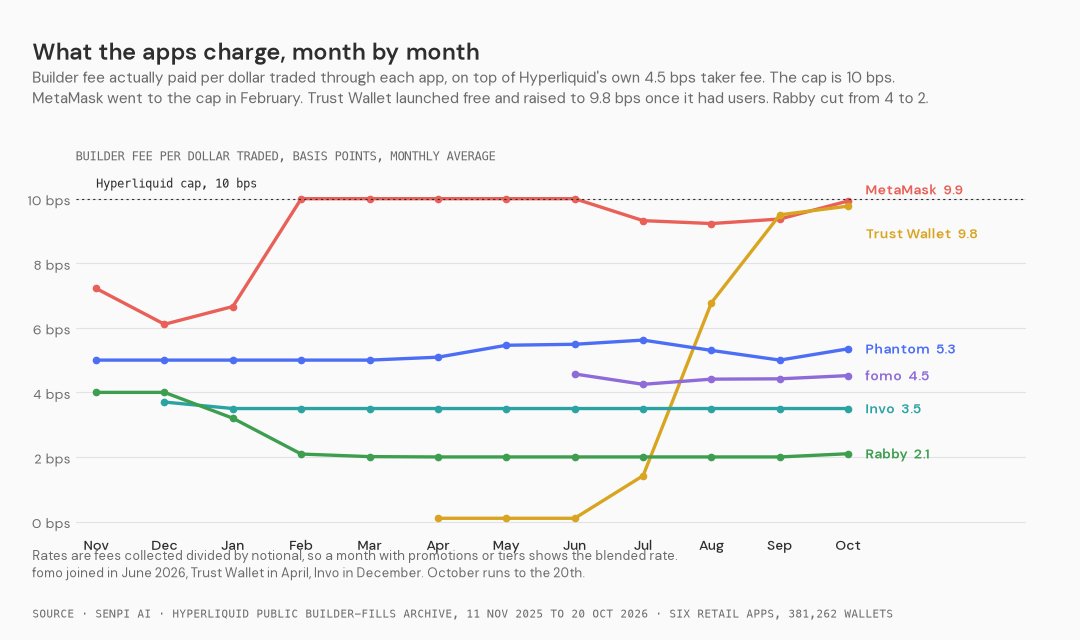
MetaMask went to the 10 bps cap in February and has stayed within a hair of it since. Trust Wallet launched in April at a tenth of a basis point, free in all but name, and raised to 9.8 bps by October once it had users. Rabby went the other way, from 4 bps in November to 2 by February. Phantom has held at 5, fomo at 4.4, Invo at 3.5.
In cents on a $100 taker order, the all-in cost today runs from 6.5 at Rabby to 14.5 at MetaMask and Trust Wallet. Hyperliquid's own share of that is 4.5 cents in every case. Everything above it is the app.
What to do about it. Builder fees are approved by you, per app, with a maximum you sign. The approval is public and revocable. If your app charges 10 bps and you turn your account over fifty times a month, the app takes 5% of your account each month before Hyperliquid, funding or a single bad trade. That is a number to know before you choose where to click and where to trade.
III. The trades the apps cannot see
The builder archive has a blind spot, and it matters for anyone reading it, including the apps themselves. It only contains fills the app routed. When a leveraged position gets liquidated, the liquidation engine closes it, not the app. The loss never carries the builder code.
On the archive alone, the six apps' users look healthy: 55% of wallets show a positive closed P&L and the population is up $70.8M on the trades it closed through the apps. Pull every fill for the same wallets from the public API and the picture flips. 50% of wallets were liquidated at least once, and 56% of the wallets that ended net negative were. On all fills, 22% of wallets are net profitable, not 38%. Only 12% of the wallets that were ever liquidated ended ahead; 32% of the rest did.
Hyperdash's $280M comes from full wallet histories, so it has the liquidations in. Every number in the rest of this piece does too.
What to do about it. If you are evaluating an app, a vault, or a trader by the trades they closed, ask what closed the others. On Hyperliquid, a wallet's liquidations are public. They are the half of the ledger that the marketing never shows.
IV. The counterfactual: the same trades at a lower fee
Take every wallet, keep every trade exactly as it happened, and change one number: the builder fee. Nothing else moves. No one trades more because it is cheaper, no one trades less. This is the most conservative version of the question, because the real effect of a lower fee includes behaviour we are not modelling.
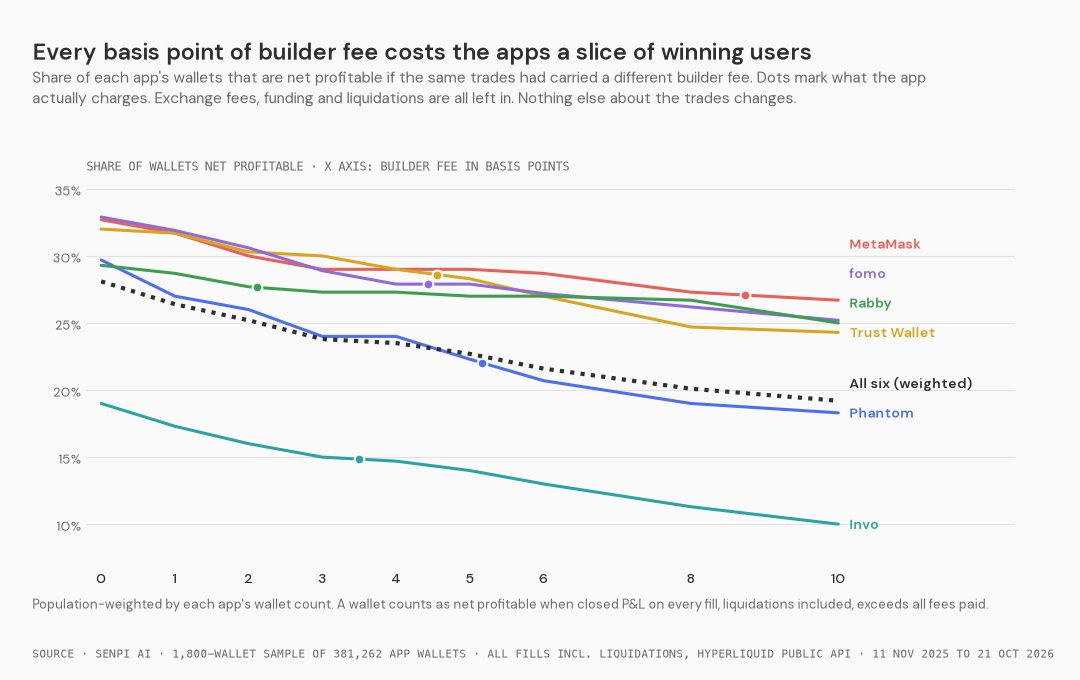
The curve is close to a straight line for every app. Each basis point of builder fee removes 0.9 points of the population from net profitable. MetaMask at 10 bps sits furthest down its curve; Rabby at 2 bps sits near the top of its own.
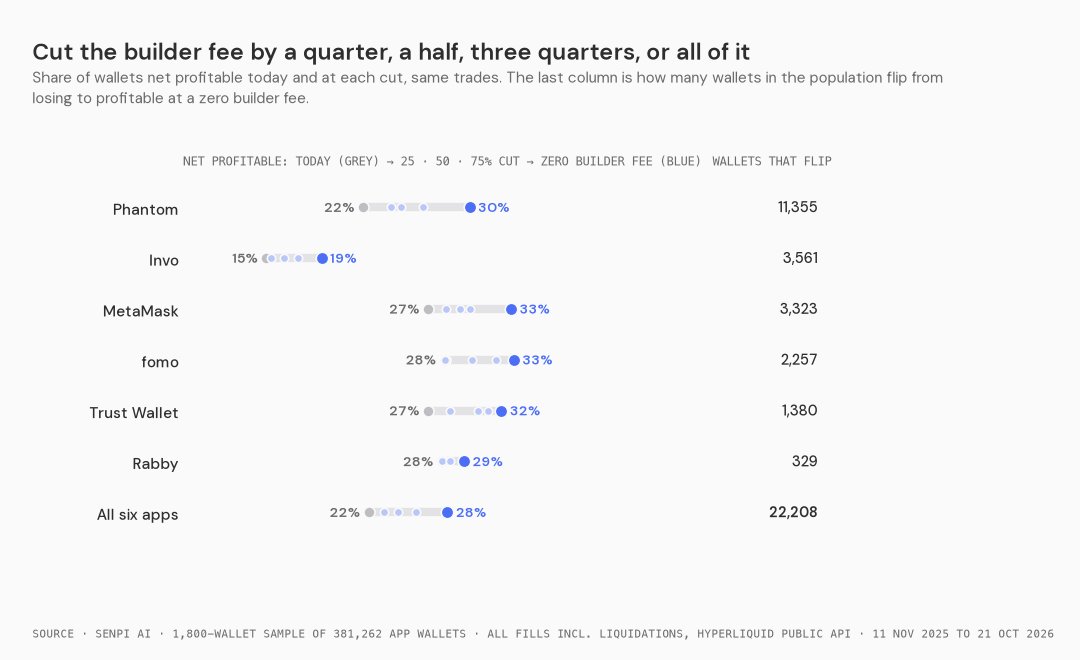
Cut by cut, across all six apps weighted by their wallet counts:
Builder fee | Wallets net profitable | Wallets that flip to profitable |
|---|---|---|
As charged today | 22.4% | – |
Cut by a quarter | 23.5% | 4,363 |
Cut by half | 24.5% | 8,387 |
Cut by three quarters | 25.8% | 13,184 |
Zero builder fee | 28.1% | 22,208 |
Source: Senpi AI, 1,800-wallet sample of 381,262 app wallets, all fills including liquidations, Hyperliquid public API, 11 Nov 2025 to 21 Oct 2026. Weighted by each app's wallet count.
The same results app by app, from the charts in this piece:
App | Builder fee, Oct 2026 | Net profitable today / at zero fee | Wallets that flip at zero | Fees in the median loss / builder fee alone | Liquidated at least once |
|---|---|---|---|---|---|
Phantom | 5.3 bps | 22% / 30% | 11,355 | 33% / 19% | 47% |
3.5 bps | 15% / 19% | 3,561 | 50% / 22% | 71% | |
MetaMask | 9.9 bps | 27% / 33% | 3,323 | 43% / 22% | 44% |
4.5 bps | 28% / 33% | 2,257 | 31% / 17% | 27% | |
Trust Wallet | 9.8 bps | 27% / 32% | 1,380 | 39% / 12% | 39% |
Rabby | 2.1 bps | 28% / 29% | 329 | 16% / 2% | 61% |
All six apps | – | 22% / 28% | 22,208 | 37% / 15% | 50% |
Builder fee is the October 2026 monthly average per dollar traded. Net profitable and flips: same trades re-priced. Source: Senpi AI, 1,800-wallet sample of 381,262 app wallets, all fills including liquidations, Hyperliquid public API, 11 Nov 2025 to 21 Oct 2026.
Read the other way round: the builder fee turns one in five of the apps' winning traders into losing ones. One in four at Phantom, one in five at Invo and MetaMask, one in six at Trust Wallet and fomo, one in twenty at Rabby, which charges a fifth of MetaMask's rate. Halve the fee and 8,400 of those traders win again, 4,000 of them at Phantom alone.
The sample puts today's figure between 20% and 25% and the zero-fee figure between 26% and 31%, at 95% confidence. The direction is not in doubt; the size is a few points either way. Measured all-in instead, with funding and open positions included from the exchange's own portfolio P&L, the same move is 25% to 31%.
What to do about it. For a trader, this is the arithmetic of app choice. The same trades at Rabby's fee and at MetaMask's fee are 6 points apart in the odds of ending the month ahead. For an app, it is the arithmetic of the business: every basis point is a slice of your winning users, and winning users are the ones who stay.
V. Where a losing wallet's money went
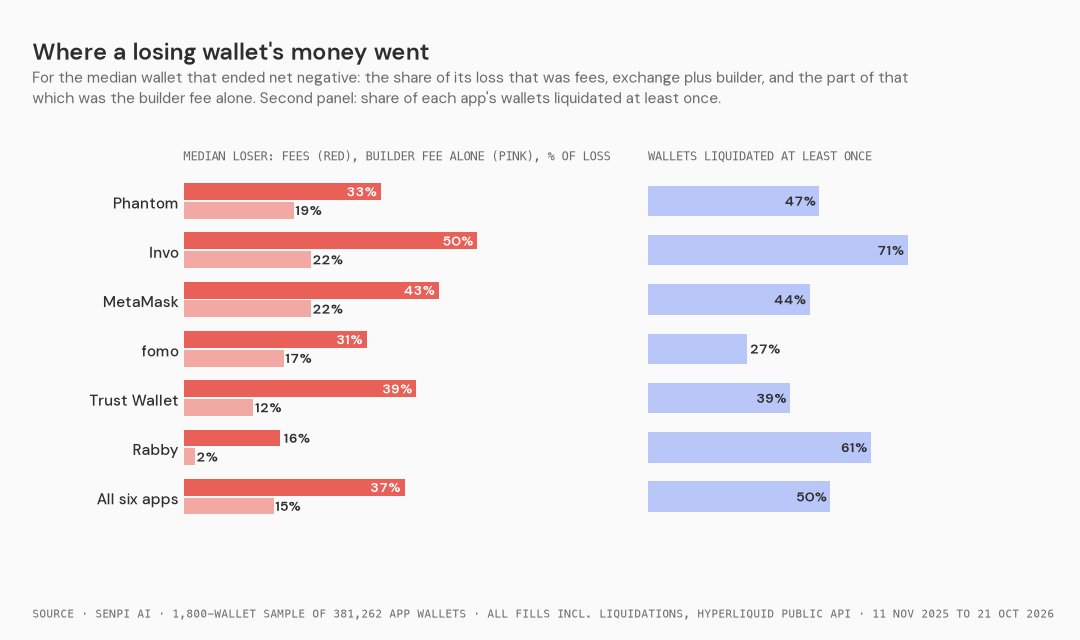
Three wallets in four ended net negative. For the median one of those, fees were 37% of the loss and the builder fee alone was 15%. For 42% of losing wallets, fees were more than half of everything they lost. The rest is trading, and the biggest piece of the trading loss is liquidation: 50% of all wallets were liquidated at least once, small accounts at high leverage closed by the engine rather than by the trader.
Before any fee, 38% of wallets were ahead on the trades they closed. Hyperliquid's own fee takes that to 28%. The builder fee takes it to 22%. Two fees, one of which the app controls.
What to do about it. Two leaks, two fixes, and neither is a better entry. The fee leak is the app's price and your turnover. The liquidation leak is size. A fixed small share of the account per position, with a stop you placed rather than one the engine places for you, removes most of both.
VI. Users who make money come back
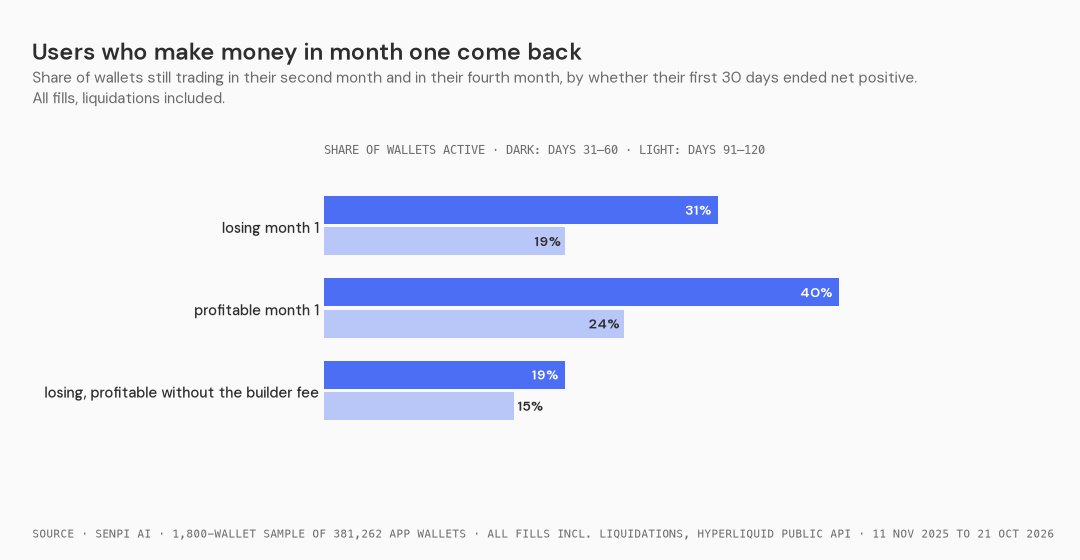
Among wallets with four months of history, 40% of those that ended their first 30 days net positive were still trading in their second month. For those that ended net negative it was 31%. By the fourth month it is 24% against 19%. The wallets that lost in month one but would have been positive without the builder fee behave like the losers, not the winners: 15% are still there in month four, though that is a small group, 32 wallets in the sample.
This is the part the apps are getting wrong. A profitable first-month wallet also pays the app more later: in the archive, wallets that were positive in month one generated 30% more builder revenue in months two to four than wallets that were negative, on 46% more volume. The fee that pushed a marginal user under water in month one cost the app that user's months two through twelve.
What to do about it. If you run an app, this is your retention curve with the cause attached. If you trade through one, your first profitable month is the one that decides whether there is a second, and the fee is the one input you control on day one.
VII. Raise, hold, cut
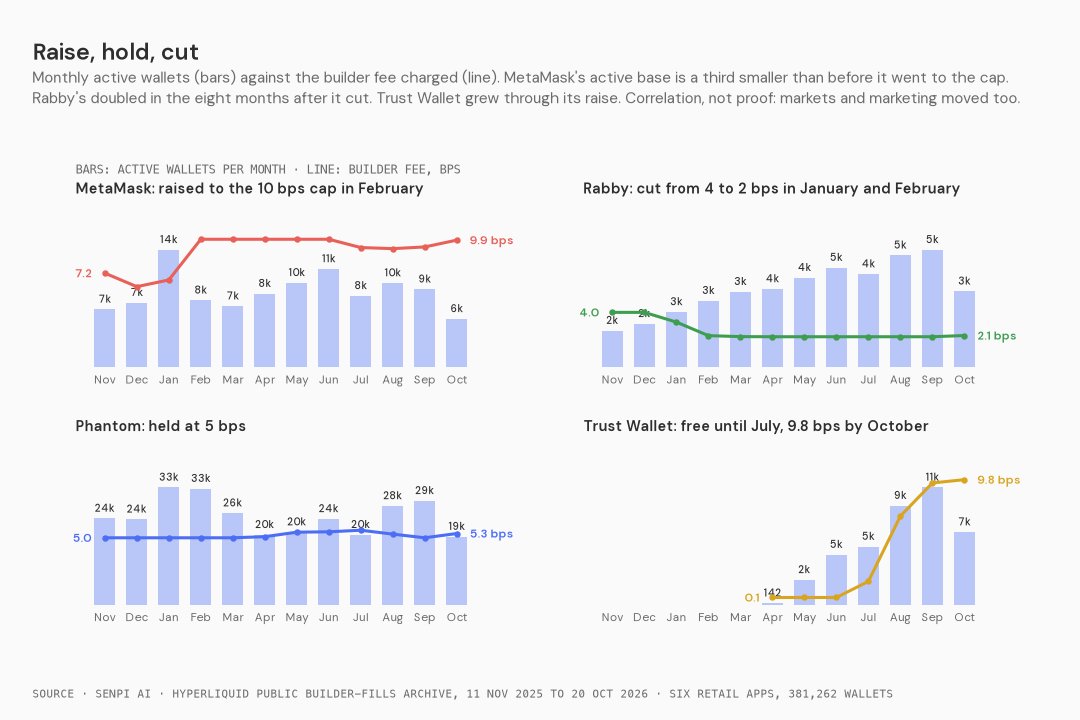
Three apps changed their price during the window, and one held it.
MetaMask raised to the cap in February; its monthly active wallets went from 13,500 in January to 9,000 in September, a third smaller. Rabby cut from 4 bps to 2 by February; its active base went from 2,500 to 5,400 over the same months, a little more than double. Phantom held at 5 and drifted from 33,000 to 29,000. Trust Wallet grew through its raise, from a free launch in April to 11,000 wallets in September at 9.5 bps, which is a reminder that distribution and marketing move these numbers too.
This is correlation, not proof. Markets rose in August and September for everyone. But the only app that cut its fee is the one whose base doubled, and the one that went to the cap is the one that shrank.
VIII. The treadmill
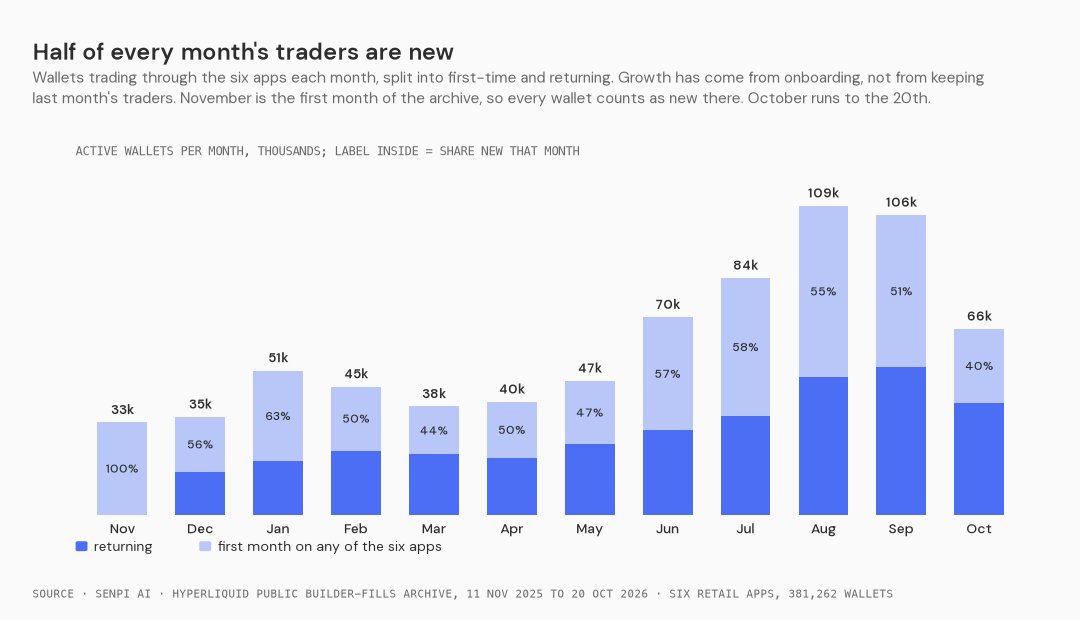
Across the six apps, 109,000 wallets traded in August and 106,000 in September. Half to 58% of them were in their first month. Of the wallets that started between November and June, 16% were still trading three months later. Growth has been onboarding, exactly as Hyperdash described, and the reason the onboarding has to be continuous is in sections IV through VI: the pricing turns new users into former users faster than it turns them into profitable ones.
Why Senpi is not in this analysis
Two reasons. Senpi is not an app in the sense used here. Senpi is the Hyperliquid intelligence layer traders run from inside Claude, ChatGPT, their terminals or ours, as a companion to the Hyperliquid terminal via our chrome extensions, and Senpi users paid a subscription for the AI first and a builder fee second, with lower builder fees based on the subscription tier, so the economics were a different shape. Since Oct 26, paid plans pay no Senpi fee; the trial and accounts without a plan pay 0.03%.
However, we have run the same test on our own book at the user level and nearly 30% more Senpi traders would swing positive if we ramped down our own builder fees in consideration for the AI subscription. And we do believe the rents are too high, so ....
That is its own piece, with a decision attached, and it is next.
Update, October 26, 2026: that piece is Why we took trading fees to 0% on Senpi AI. Every paid Senpi plan now trades with 0% Senpi fees.
On the numbers
The six apps are MetaMask (two builder addresses), Phantom, Trust Wallet, fomo, Rabby and Invo, as in Hyperdash's piece. Fills are from Hyperliquid's public per-builder daily archive at stats-data.hyperliquid.xyz, 11 November 2025 to 20 October 2026, perps only. Builder fees are exact, per fill. Hyperliquid's own fee is not in the archive; the population figure of $25.9M uses base-tier rates, 4.5 bps taker and 1.5 maker on core perps and a fifth of that on HIP-3 markets, calibrated against actual fees on 1,148 wallets we track. The counterfactual uses a stratified random sample of 300 wallets per app, 1,800 in all, with every fill pulled from the public API, so liquidations, exact exchange fees and exact builder fees are all in. A wallet is net profitable when closed P&L on every fill exceeds every fee paid; funding is excluded from that measure and included in a second, all-in measure from the exchange's own portfolio P&L, which gives 25% today and 31% at zero on the wallets whose whole history falls inside the window. Population shares are weighted by each app's wallet count; the 95% interval is a stratified bootstrap. The counterfactual is static: the same trades, re-priced. It does not model more trading at a lower fee or less at a higher one. Monthly actives, new-wallet shares, fee levels and the app-level retention figures come from the full archive. Wallets are not people; one person can run several wallets. Senpi Signals are observations, not investment advice.
Frequently asked questions
How much do Hyperliquid apps charge in builder fees?
Hyperliquid charges 4.5 basis points on a taker order at the base tier, and an app's builder fee sits on top, capped at 10 bps. In October 2026 the six largest retail apps averaged about 9.9 bps at MetaMask, 9.8 at Trust Wallet, 5.3 at Phantom, 4.5 at fomo, 3.5 at Invo and 2.1 at Rabby per dollar traded. On a $100 taker order the all-in cost runs from 6.5 cents at Rabby to 14.5 cents at MetaMask and Trust Wallet.
How many app traders would be profitable without the builder fee?
With every trade unchanged, 22.4% of the six apps' wallets are net profitable at today's fees and 28.1% would be at a zero builder fee. Halving the fee turns 8,387 losing wallets into winners and removing it turns 22,208, measured on a 1,800-wallet sample with every fill, liquidations included, from 11 November 2025 to 21 October 2026.
Why do the apps' own records make their users look profitable?
The builder archive only holds fills the app routed. Liquidations are closed by Hyperliquid's liquidation engine and never carry the app's builder code. On the archive alone 55% of wallets show a positive closed P&L; with every fill pulled from the public API, half of all wallets were liquidated at least once and 22% are net profitable after fees.
How can I see how much builder fee I pay on Hyperliquid?
Every fill in your Hyperliquid trade history carries the builder fee as a separate line, so you can add it up for a month. You approve each app's builder fee with a maximum you sign, and the approval is public and revocable. At 10 bps and fifty times account turnover a month, the app takes 5% of the account each month.
Does Senpi charge a builder fee?
Not on paid plans. Since October 26, 2026 every paid Senpi plan trades with 0% Senpi fees, so you pay Hyperliquid's own exchange fee and nothing else to Senpi.