
Senpi is building Cursor for Trading. That means building for professionals first.
Jason Goldberg on why Senpi builds Cursor for Trading for professionals first: 2,009 desk-scale Hyperliquid wallets and where AI moves the value.
Originally published on X on October 21, 2026. Read the original on X.
On Hyperliquid, 2,009 professional wallets do 87% of the volume, excluding market makers — and 82% of them do not route through app builder codes. The professionals who operate those books are who we are building for, and building for them is how everyone else gets better tools.
From day one at @senpi_ai we set out to build Cursor for Trading: AI agents that turn plain language into live, deterministic, risk-managed trading strategies — and get sharper about you every time you use them, anywhere you research or trade.
Cursor, Claude Code and Codex were built first and foremost to give experienced developers leverage. Doing that well is what made them good enough that people who had never shipped code could suddenly write software — more of them than ever before. The novices arrived through a tool sharpened against professionals, not through a product built down to them. The same shift is arriving in trading, and we are building it the same way round.
First, the reality check: we are still at the dial-up stage of AI adoption
Make no mistake — AI is coming for every industry. Not some of them. Every one. And we are far earlier in that than it feels from inside the news cycle. Measured against internet adoption, this is the dial-up stage: enough people are online to argue about it, nowhere near enough for the consequences to have landed.
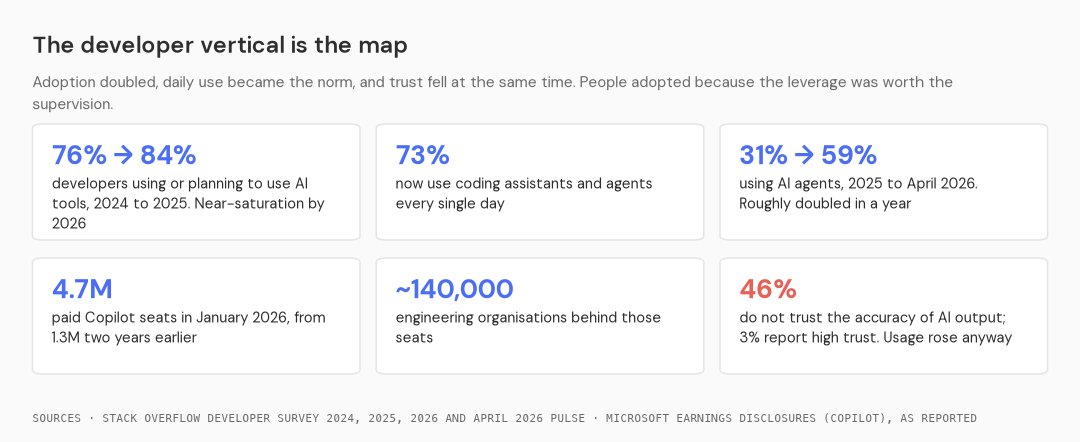
The developer vertical is the furthest along, which makes it the best available map of the curve. Stack Overflow has asked the same questions every year. In 2024, 76% of developers said they used or planned to use AI tools. In 2025, 84%. By 2026 the survey calls adoption near-saturation — and by then the bar had moved. 73% now use coding assistants and agents every single day. Not tried once, not planning to. Daily.
But the headline number hides the real story, which is the agents. Agent adoption among developers went from 31% in 2025 to 59% by April 2026. It roughly doubled in a year. GitHub Copilot’s paid seats went from 1.3 million in January 2024 to 4.7 million in January 2026 — and paid seats matter, because somebody signed a purchase order for every one of them.
Two conversations I keep thinking about
About a year ago I interviewed a genuinely strong developer. Deep experience, good judgement, the kind of person you want. I asked how they used AI day to day and how that had changed over the previous six months. The answer was: “I don’t really use AI to code, and I’m not a fan of vibe coding.”
Six months ago I asked a quant engineer how they would use their experience to build the best AI quant coding agent. The answer was: “I don’t believe AI will ever replace real quant engineers.”
Neither answer was stupid. Both were reasonable positions, held by capable people, arrived at honestly — and both were already being overtaken while the words were being said. Look at the dates against that adoption curve. The developer was speaking in the window when agent use among their peers was about to double. The quant engineer answered a question I had not asked: I asked how they would build the thing, and they told me why it would not replace them.
The question was never whether AI replaces the expert. It is whether the expert leverages the tool faster and smarter than the person sitting next to them does.
That is the pattern in every vertical so far, and it is why I am wary of the confident version of this argument in either direction. The people who said AI would make developers obsolete were wrong. The people who said it would not touch their craft were also wrong. What actually happened is less dramatic and far more consequential: the work stayed, the tooling changed underneath it, and the gap between people who adopted early and late became the thing that mattered.
AI trading is now where software development was in roughly 2025. Which is to say: early enough that saying so still sounds like a pitch, and late enough that the curve has already started.
Step by step, here is the argument.
Build for the professionals, and everyone else wins
Senpi is built for professionals and the prosumers becoming them. People for whom this is a job, a serious second income, or a craft they are deliberately getting good at. Not the person with $50 in a brokerage app chasing a ticker they saw on a feed. We will attract some of those — every product in this market does — but they are not who we design for, price for, or measure ourselves against.
And here is the part worth saying plainly, because plenty of the people using Senpi today sit closer to the retail end than the professional one: building for the professional is how everyone else wins.
Cursor did not get good by aiming at people who had never written code. It got good by serving engineers who would notice instantly if it was wrong, argue about the diff, and leave if it wasted their time. The beginner then inherited a tool hardened by the most demanding users in the market. Nobody shipping their first app today is using a product designed down to them; they are using one built up to a professional standard and handed over.
The same cascade applies here, and it matters more in trading than it did in software, because here the cost of a bad tool is money rather than a wasted afternoon. A risk engine that satisfies someone running outside capital is the same risk engine protecting somebody’s first $500. Execution discipline built for a desk doing six thousand fills a month is what stops a new trader blowing up on their third. Aim at the person who can tell the difference, and everyone downstream gets something better than anything built for them directly.
Two of those segments are businesses, and the difference between them is the whole go-to-market:
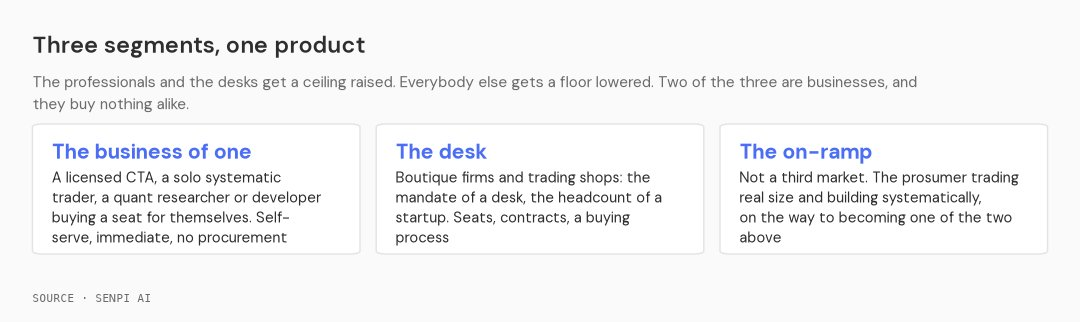
The first two are both businesses, and that is the trap. A solo quant running outside capital is a business, and buys like one — they decide on a Tuesday and start the same afternoon. A fifty-person shop is also a business and buys nothing like that. Same product, same value, completely different motion. Most companies pick one and discover the other too late.
What separates them is not ambition or intelligence. It is how much machinery each can afford to put behind an idea. That is the part which just got cheap, which is why one product can serve a business of one and a business of fifty — and why the consumer end of our line is a prosumer climbing toward both, not a casual account we are chasing.
You can see the line clearly in the venue data later in this piece. The bottom band — wallets trading under $100,000 a month, a median of 23 fills across 2 assets on 2 days — is a different activity from the band above it, and a different business. Nearly half of that bottom band already uses a consumer app, and those apps serve them well. We are aiming at the rungs above: the trader doing real size and real frequency, who currently has no tooling at all.
How big is the professional traders universe?
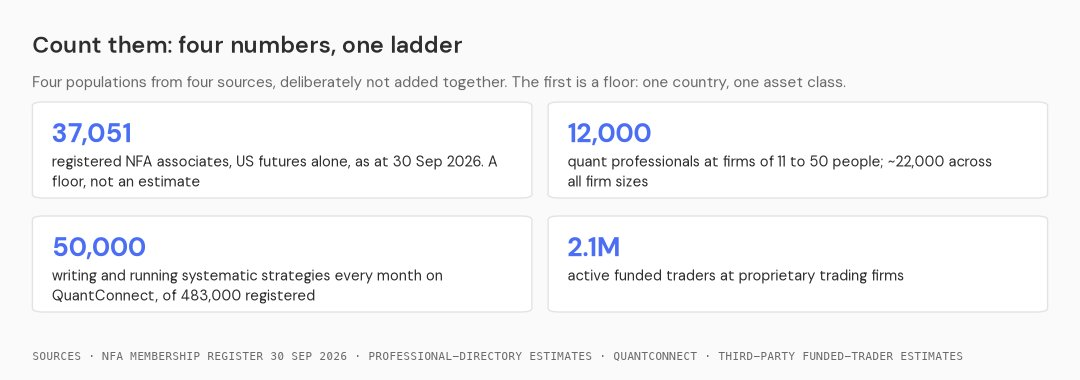
37,051 registered trading professionals. 12,000 quants at boutique firms. 50,000 people writing strategies every month. Two million funded traders. Those four numbers come from four different places, and together they describe one ladder.
The registered professionals
In the United States, anyone who trades futures for other people has to register. As of 30 September 2026 the National Futures Association lists 1,152 Commodity Trading Advisors and 1,025 Commodity Pool Operators inside 2,720 member firms — and 37,051 registered associates, the individuals licensed to do the work.
That is one country and one asset class. It does not count the securities-side quants, the crypto desks, the systematic shops in London, Amsterdam, Singapore, Hong Kong, Mumbai or São Paulo, or anyone trading proprietary capital who never needed to register at all. So treat 37,051 as a floor, not an estimate. Around it sit roughly 15,000 hedge funds globally, a large and growing share of them systematic, and 2,000-plus proprietary trading firms worldwide. The true global number is certainly a multiple of the US futures register; I am not going to invent the multiplier, because the floor is already large enough to matter and a made-up number would only weaken it.
The boutiques, where most of the work happens
The centre of gravity does not sit at the top. It sits much lower down: roughly 12,000 quant professionals at firms of eleven to fifty people, and around 22,000 across all firm sizes on a tight definition of the job titles. Researchers, systematic traders and quant developers at shops with real capital and a handful of staff — the mandate of a desk, the headcount of a startup. No platform team, no execution engineer, nobody whose job is to build a risk harness. The work still has to get done.
And the much larger group building anyway
483,000 people have registered on QuantConnect, and about 50,000 use it every month — writing, backtesting and deploying systematic strategies, on a platform that charges them for the privilege. Numerai runs a tournament where 2,869 data scientists submit models and 673 stake their own money behind them. The algorithmic trading community on Reddit alone is 1.9 million people, and the retail proprietary firms have roughly 2.1 million active funded traders between them.
Nobody sensible would call all of these people quants. But every one is doing the thing a quant does: forming a hypothesis about a market and trying to express it as a process rather than a hunch. That is the market Senpi is built for — not three separate products but one continuous line, running from a licensed CTA managing outside capital down to somebody who has just discovered that a rule can be written down and tested.
Three segments, one product. The professionals and the desks get a ceiling raised. Everybody else gets a floor lowered.
Why one product serves professionals and prosumers: the Cursor parallel
Cursor, Claude Code and Codex did two things at once. They let people who had never written software ship working products — the half everybody talks about. They also made the strongest engineers dramatically more productive, which is the half that funded the category. Both work because the tool removes the same constraint for each group: for the beginner it is knowing the syntax, for the expert it is hours in the day. What is left when those go is judgement about what to build, and experts have more of it. The leverage grows with skill rather than shrinking.
One detail from the developer data is worth carrying across. While adoption climbed, trust fell — 46% of developers told Stack Overflow in 2025 they did not trust the accuracy of AI output, up from 31%, with only 3% reporting high trust. Usage rose anyway. People did not adopt because they trusted the model. They adopted because the leverage was worth the supervision.
That is the design brief for trading, where a wrong answer costs money immediately rather than failing a unit test. The agent proposes; a deterministic runtime executes, with a declarative risk and exit layer, position reconciliation, slot limits and crash recovery beneath it. The trader approves actions. The model never has the last word on risk — and that is what makes the leverage usable rather than merely impressive.
Quant trading then has exactly the same shape as software. A researcher is rich in ideas and poor in hours; the ceiling has always been how many hypotheses one person can specify, code, test and discard in a week. Ten, working hard. An agent that does the grinding makes it a hundred, and the new constraint becomes knowing which hundred are worth testing. Meanwhile somebody with a genuine market view and no Python can describe a strategy in plain English and have it written, deployed, sized and risk-managed.
Onchain Validation
Most markets you have to estimate. Trading on a public chain you can count. We took the thirty days to 20 October 2026 — 14,018 active wallets and $186.7bn of notional — and removed the market makers first.
That matters, and it is the step most analyses skip. Market makers quote both sides continuously; they are not expressing a view and they are never going to buy a research tool, because they built their own years ago. Senpi’s own market-maker detector flags 347 of those wallets, and they carry $44.6bn of the notional. Strip them out and what is left is 13,671 wallets trading $142.1bn — people taking positions because they think something is going to happen.
The whole population is visible in one table. At the top, 2,009 wallets operating at desk scale, none of them market makers — in the $10M–100M band the median wallet puts through 5,901 fills across nine assets on twenty separate days a month, which is a systematic operation run by one or two people. Together they do 87% of all non-market-maker volume and pay about $370M a year in trading fees. Below them, nearly 11,700 more wallets working up the same ladder.
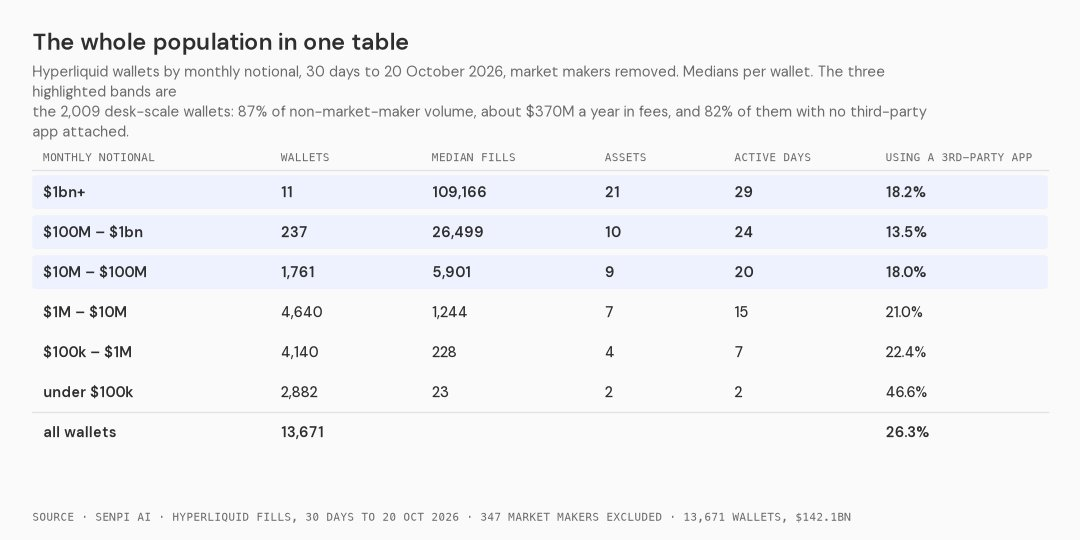
And 82% of those desk-scale wallets have no third-party app attached at all — which is to say the field is wide open. These are serious operators, already spending real money on the activity, who have simply never been sold the right tool.
The apps mainly serve the small accounts.
Every fill on Hyperliquid can carry a builder code identifying the third-party app that routed it. An important caveat: the absence of a code does not mean the trader wrote their own access — Hyperliquid’s own native interface attaches no builder code either, so that bucket holds native-interface users and API traders together. What it does tell you, cleanly, is whether a third-party product is in the loop.
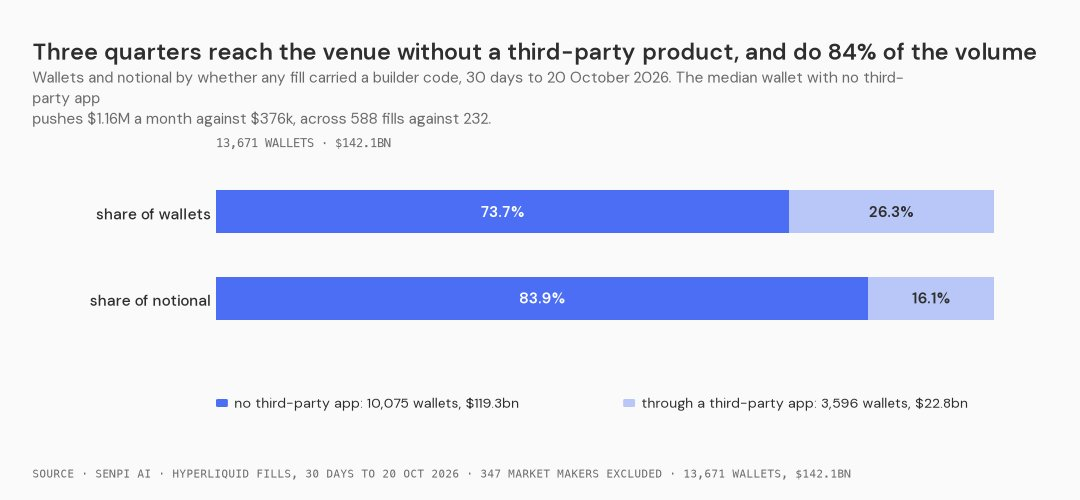
Three quarters of active traders reach the venue without any third-party product in the loop, and they do 84% of the volume. The median wallet in that group pushes 3.1× the notional of the median app user, across 588 fills a month against 232.
The gradient is the striking part. App usage falls steadily as size rises:
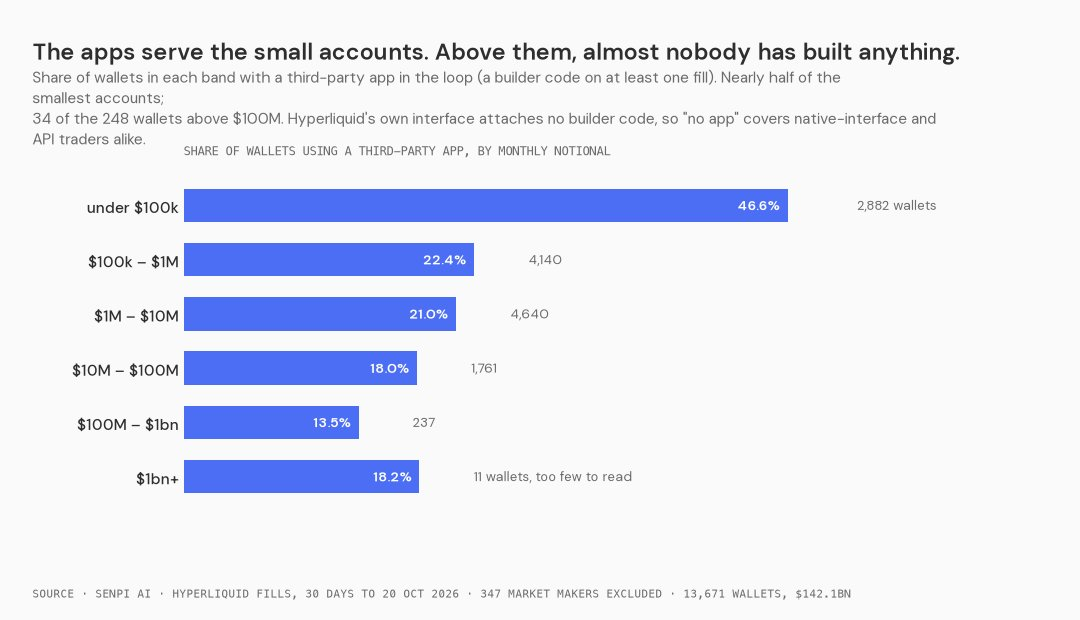
Nearly half of the smallest accounts use a third-party app. Across the $100M-and-up wallets it is 34 out of 248 — under one in seven, and the eleven billion-dollar books at the very top are too few to read a trend into. Front-ends have built, very successfully, for the bottom of the ladder — and the further up you go, the more completely unserved the trader becomes. Not because they refuse software, but because nobody has offered them software worth adopting.
What Professional Traders Need: follow their prompts
Senpi enables traders to prompt their AI agents in plain English.
We publish an AI-curated feed of real user prompts and their agents' answers, unedited and curated only for what another trader could borrow, at senpi.ai/feed.
It is the clearest read we have on what pro traders need:
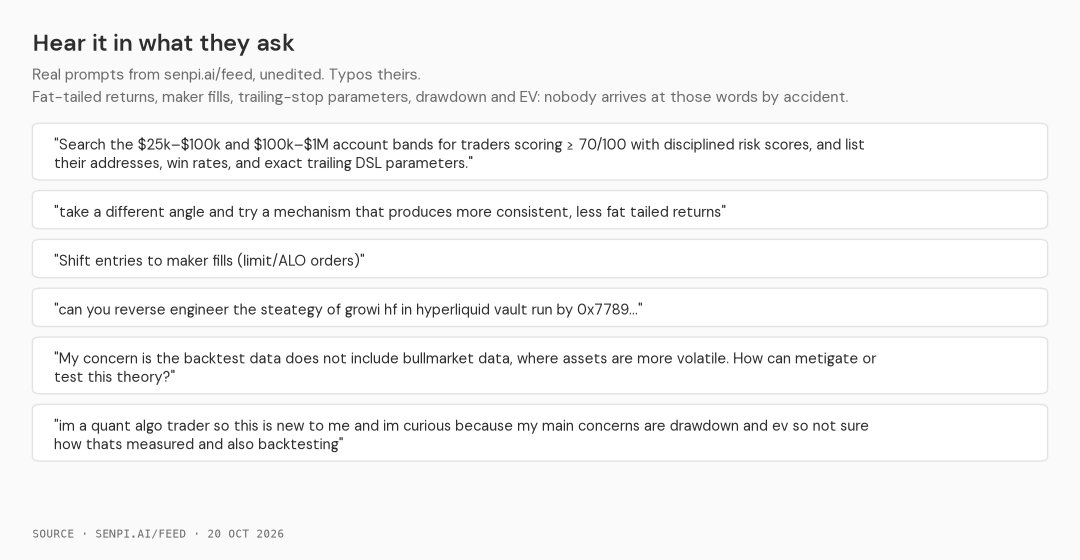
Look at the vocabulary. Fat-tailed returns. Maker fills. Trailing-stop parameters. Drawdown and EV. Backtest regime bias. Nobody arrives at those words by accident. Searching two account bands for traders above a risk-adjusted threshold and extracting their exact stop parameters is a research project. Reverse-engineering a live vault’s strategy from its onchain behaviour is a week of analyst work.
And the last one is the whole thesis in a single sentence. “im a quant algo trader so this is new to me… my main concerns are drawdown and ev.” A professional, arriving with exactly the right questions, who has not used a tool like this before. That is the person we are building for, and there are a lot more of them than there are people asking which ticker goes up.
This is measurable, not anecdotal
We classified every human-typed conversation from the past seven days — 1,634 of them, from 439 people — by the language used.
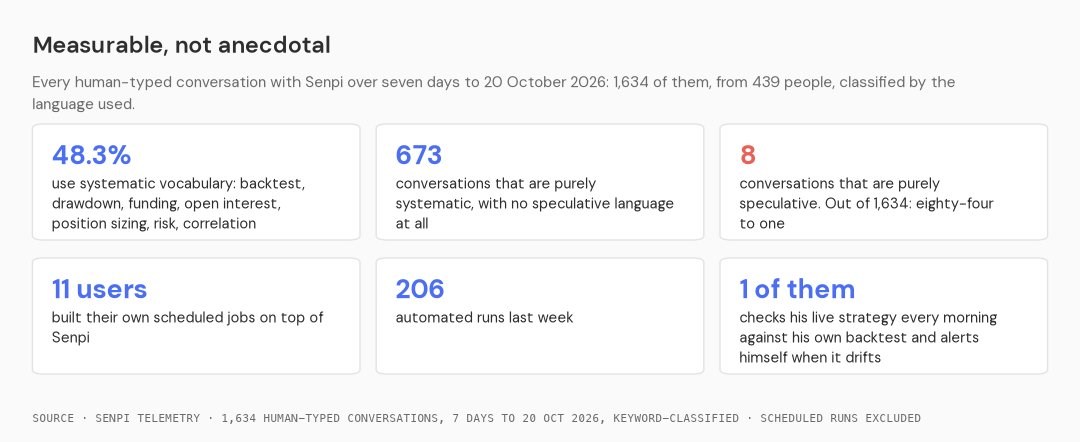
Roughly eighty-four purely analytical conversations for every purely speculative one. Whatever else is true of crypto, the people showing up to ask an AI quant for help are not the ones chasing the next ticker. They arrive with a hypothesis and a risk question.
Eleven users have gone further and built their own scheduled jobs on top of Senpi — 206 automated runs last week. One checks his live strategy every morning against his own backtest benchmarks and alerts himself when it drifts. He built a monitoring system because the primitives were there. That is an expert extending a tool, which is precisely what engineers did the moment they got agents.
Where the value moves with AI
All of these people already buy tools, and the spending is not small. Here is the stack they buy today, from the institution down to the individual.
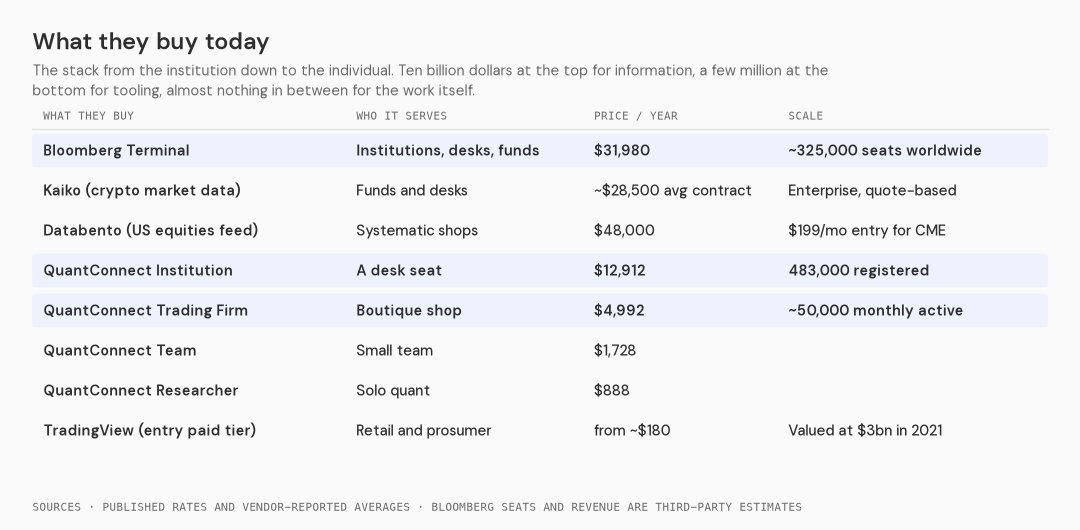
Two numbers in that table are worth sitting with.
The first is Bloomberg: roughly 325,000 seats, generating an estimated $10–13bn a year, which is more than 85% of the revenue of one of the most profitable private companies in the world. That is what a market pays, annually, for information a human then has to act on. It is the single largest proof that this buyer will spend real money on an edge.
The second is the opposite end. QuantConnect has 483,000 registered users and about 50,000 monthly actives, and third-party estimates put its revenue in the single-digit millions. Call it somewhere around a hundred dollars a year per active user. An enormous, sophisticated, self-selected population of people building trading systems — monetised at roughly a three-hundredth of a Bloomberg seat.
Ten billion dollars at the top for information. A few million at the bottom for tooling. Almost nothing in between for the work itself.
That gap is not a pricing failure by either company. It is structural, and it is exactly what AI dissolves.
Look at what that money buys. Bloomberg sells data a person still has to read. QuantConnect sells a backtester a person still has to write strategies for. Databento and Kaiko sell feeds somebody still has to model. Every one of them sells an input, and a skilled human converts those inputs into a trade.
That is the shape of every pre-AI software market, and it explains the strange distribution above. The top of the stack is expensive because institutions can afford to pair $32,000 of data with a $300,000 analyst. The bottom is cheap because an individual cannot — so they get the tool without the labour, and the tool alone is worth very little. The price of software in this market has always been set by how much human time sat on top of it.
Every vertical AI has entered has moved the value from the input to the output. The incumbent sells the raw material; the AI-native product delivers the finished work, absorbs the incumbent’s category as a feature, and earns the whole budget line. Design, legal research, customer support, code. Trading is the largest workflow where that shift is still ahead of us.
The developer vertical already shows what that is worth. Copilot’s 4.7 million paid seats did not come out of a hobbyist budget — they came from engineering organisations, nearly 140,000 of them, which decided that an engineer with an agent is worth materially more than one without. That is the B2B half of this category, and it arrived faster than the consumer half.
What “the work” concretely means
That phrase is easy to say and worth making specific. When Senpi reads a single asset, it scans seven days of price action, pulls top-trader positioning, verifies smart-money alignment against the crowd, captures whale movements and fresh entries, reads the four-hour winners board, checks funding, open interest and liquidations, and compares the move against BTC and the S&P 500. Then it scores the read and shows its sources.
That is perhaps forty minutes of competent analyst work, per asset, per look. A desk watching nine assets — the median for the band we measured — cannot do that continuously on human hours, which is why nobody does. The work does not get done badly; it does not get done at all.
Then the other half: describing a strategy in plain English and having it written as code, deployed to its own wallet, sized by rule, and governed by an explicit risk and exit policy that runs whether or not anyone is watching. That used to be a quant developer, an execution engineer, and a risk system. Those three roles are the $300,000 column.
They sell the trader better tools.
We sell the trader the work.
Meet them where they already are
A licensed CTA, a two-person systematic shop and someone deploying their first strategy have almost nothing in common except this: none of them is going to move house to try a new product.
So over the past four weeks we brought Senpi to them. It runs inside Claude, ChatGPT, Grok, Codex, Cursor, Hermes and Muse through Connectors, and beside 28 trading terminals, scanners and X through a Chrome extension. More than half of all Senpi users have now connected their agent to an AI app they already use — the fastest adoption of anything we have shipped, because nobody had to change where they work.
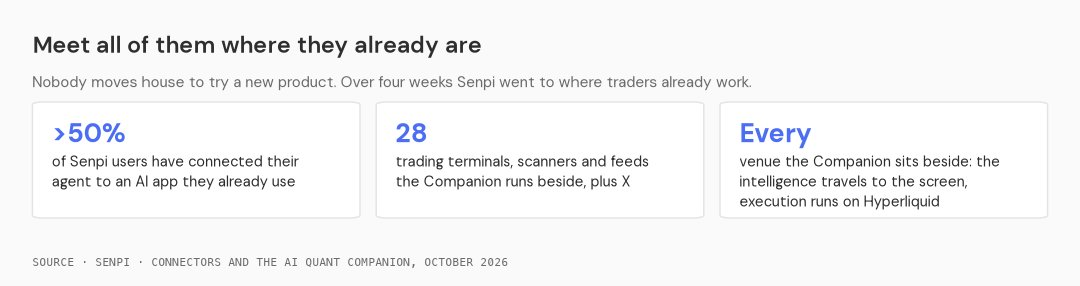
That is the same reason the coding agents won. They showed up inside the editor people already had open.
There are tens of thousands of registered professionals, tens of thousands more at boutique firms, hundreds of thousands building strategies on their own, and millions trading seriously enough to pay for the attempt. They sit on one continuum, and the thing that separates them is how much machinery they can afford to put behind an idea.
That is the part which just got cheap. The best traders are about to become considerably better, and a very large number of serious-but-under-equipped traders are about to run a real strategy for the first time. Both at once — which is exactly what happened to software.
What this bet depends on
Every thesis like this rests on a few things that have to be true. I would rather name ours, and say what we are doing about each, than leave them for someone else to find.
Edge has to survive being found. If a research agent in every hand means every discoverable pattern is arbitraged in days, the tool raises everyone’s floor and nobody’s ceiling. The same was said of the ticker tape, the terminal and the backtester, and each time analysis became more valuable, not less, because the edge moved from finding the pattern to acting on it with discipline. That is where the agent earns its keep: the work after the idea, and that work does not decay.
Supervision has to scale. A developer can review a diff. A trader cannot review a thousand decisions a day. So the thing that has to be trustworthy is not the model but the layer under it: a deterministic runtime, a declared risk and exit policy, reconciliation, limits, recovery. We built that layer as the product, not as a feature, and it is what lets a trader hand over the work without handing over the judgement.
The desks have to pay. We can count 2,009 desk-scale wallets and show that 82% of them have no third-party product in the loop. No desk is a Senpi customer today and no desk price has been quoted. That is not a hole in the thesis; it is the next thing we prove, and the data tells us exactly whose door to knock on and what they already spend.
The direction is not in question.
What is in question is who builds the harness traders trust.
The direction has run through every vertical that got there first. That last question is one about execution, and it is ours to answer.
On the numbers. Developer adoption figures are from the Stack Overflow Developer Survey (2024, 2025 and 2026) and its April 2026 pulse; GitHub Copilot seat counts are from Microsoft earnings disclosures as reported by third parties and should be checked against the primary filings before reuse. Bloomberg seat counts (325,000) and revenue ($10–13bn) are third-party estimates; Bloomberg L.P. is private and does not publish them. QuantConnect user counts and prices are its own published figures; its revenue is a third-party estimate. Kaiko, Databento and TradingView prices are published rates or vendor-reported averages. NFA registration counts are from the NFA membership register as at 30 September 2026. Hedge fund and proprietary trading firm counts are industry estimates and vary materially by definition. The 12,000 and 22,000 figures are professional-directory estimates. QuantConnect and Numerai figures are published by those platforms; the Reddit and funded-trader figures are third-party estimates. Venue figures are from thirty days of Hyperliquid fills to 20 October 2026, segmented by monthly notional; the window is fixed at 20 September to 20 October 2026, and market makers are excluded throughout using Senpi’s own market-maker detector (1,069 flagged addresses as at 20 October 2026, of which 347 were active in the window), so every venue table in this piece reconciles to the same 13,671 non-market-maker wallets and $142.1bn; routing is taken from the builder-code field, so a wallet counts as app-routed if any fill carried one — note that Hyperliquid’s own native interface attaches no builder code, so “no third-party app” covers native-interface and API traders alike, and is not a claim about who writes their own code; fee figures are thirty-day totals, annualised where stated; one operator may run several wallets, so wallet counts are an upper bound on firms. Senpi prompt classification covers 1,634 human-typed conversations over seven days to 20 October 2026, keyword-classified; scheduled and automated conversations are excluded. These populations overlap in unknown amounts and are deliberately not added together. Senpi Signals are observations, not investment advice.