
Why we took trading fees to 0% on Senpi AI
Jason Goldberg on why every paid Senpi plan now trades with 0% Senpi fees: what our fee did to our own traders, what app fees cost Hyperliquid traders, and why Senpi is an inference business.
Originally published on X on October 26, 2026. Read the original on X.
Starting today, every @senpi_ai plan trades with 0% Senpi fees.
No markup on your fills, no basis points taken from every trade. You pay Hyperliquid's own exchange fee, and nothing else to us.
This is not a promotion and it is not a gift. It is a correction, and once we ran the numbers it was a no-brainer. We looked at what our trading fee earned, what it cost the people paying it, and what it was doing to the kind of trader we are building for. The arithmetic was backwards, so we fixed it. Here is the whole case, with the numbers.
I. We ran the numbers on our own traders
When we launched Senpi agents in July we did not know where traders would find the most value, so we built all of it: the intelligence, the runtime that runs strategies around the clock, and the execution underneath. We charged a small builder fee on every fill, the way every app on Hyperliquid does, and we set out to measure which parts people came back for. The plan all along was to follow the data and change the pricing the moment the answer was clear.
After 90 days it was clear. We took every fill on every Senpi strategy wallet from 24 July to 22 October, removed our own accounts and anyone who had not touched their agent in that window, and asked one question: what did our fee do to these people?
It turned winners into losers. 29% of our traders finished the quarter net positive. At a zero Senpi fee, with every trade left exactly as it happened, 42% would have. That is 46% more of our own traders finishing green, and the only thing standing between them and a profitable quarter was a line item we controlled.
It worked against retention. Senpi traders who finish their first month net positive are still trading in month four at a 45% higher rate than those who finish it negative. Profitable traders rarely leave. Every trader the fee pushed from green to red was a trader we were more likely to lose, and we were doing it for six dollars.
II. Senpi users were already paying us for something else
The second finding was the one that made the decision easy.
Our AI inference business, subscriptions plus top-up AI credits, is up 3x in the last 60 days. It passed trading-fee revenue in September and it is now twice it. Users who buy more inference on top of their plan average $114 a month with us. Those same users paid about $16 a month in trading fees.
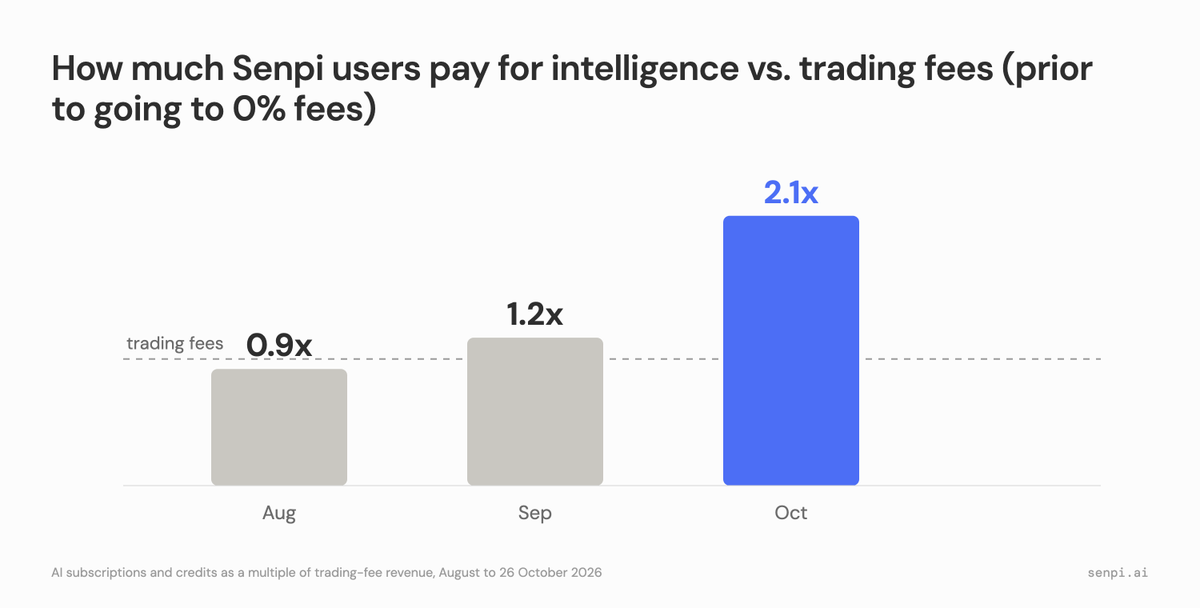
The $16 is the whole point. We have spent the past weeks watching, analyzing and talking to these users. They come in and gladly pay Senpi for AI inference long before they put any serious volume through Senpi, and in conversation they tell us the same thing: they have unlimited budget for intelligence that helps them trade smarter. Where they execute is their business. Some route through Senpi, some trade on the exchange directly, some through the apps, and with the connectors and the browser companion Senpi goes with them to all of it. A fee that only ever touched the slice of their trading that happened to pass through us was never going to be the business. The intelligence is.
III. The rent across the venue is too damn high
App fees are killing user profitability and causing high churn.
Hyperliquid publishes every fill that carries a builder code, so the question can be computed rather than argued. We re-ran the full histories of the six retail apps, MetaMask, Phantom, Trust Wallet, fomo, Rabby and Invo: 381,262 wallets and $67.5bn of trades over eleven months, then pulled every fill, liquidations included, for an 1,800-wallet sample to get each trader's real outcome. Then we re-priced the same trades at a lower builder fee and counted who ends up net profitable.
At the fees the apps charge today, 22% of their wallets are net profitable. At zero, with nothing else about the trades changed, 28% would be. The builder fee turns one in five of the apps' winning traders into losing ones, and one in four at Phantom. Halve it and 8,400 traders who lose today win again. The apps collected $34.5M from those wallets to keep it that way.
For the median losing wallet, fees were 37% of everything it lost, and the app's cut alone was 15%. For four losing wallets in ten, fees were more than half the loss.
The apps have run the experiment on themselves. MetaMask raised its fee to the 10 bps cap in February and its monthly active wallets fell by a third. Rabby cut from 4 bps to 2 over the same months and its base doubled. Correlation, not proof, but the only app that cut is the one that grew, and the one that went to the cap is the one that shrank. And the treadmill keeps turning: half of every month's app traders are in their first month, and of the wallets that started between November and June, 16% were still trading three months later.
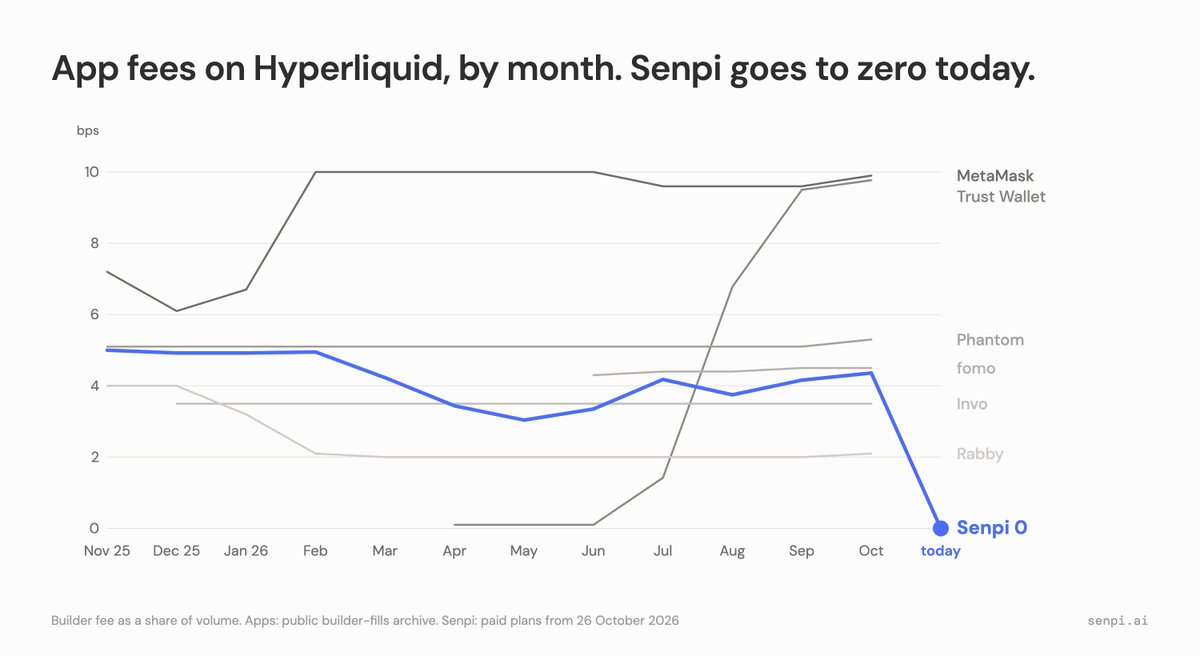
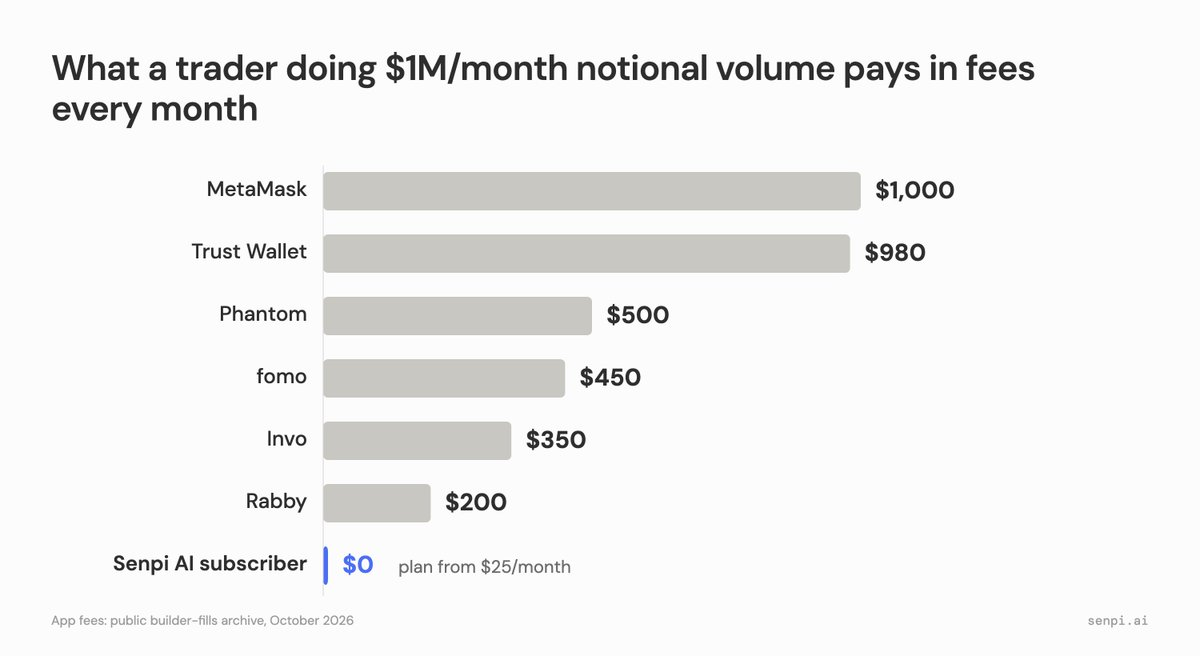
Here is what every app charges on top of Hyperliquid's own 4.5 bps, which everybody pays, from the public builder-fills archive as of October 2026:
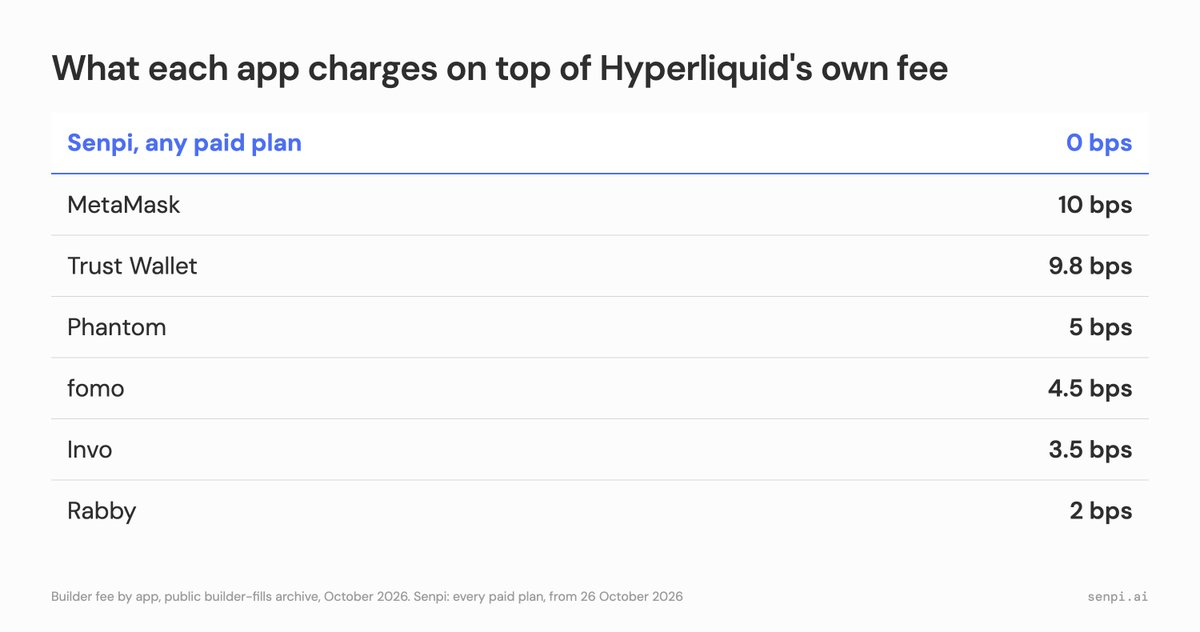
A trader doing $1M of notional a month pays MetaMask or Trust Wallet about $1,000 for the privilege of clicking through their app. On a paid Senpi plan they pay nothing, and they get an AI quant on every move. As of today, Senpi is the only one of these seven at zero.
IV. The apps churn the traders they tax. Our subscribers stay.
The fee question and the retention question turn out to be the same question.
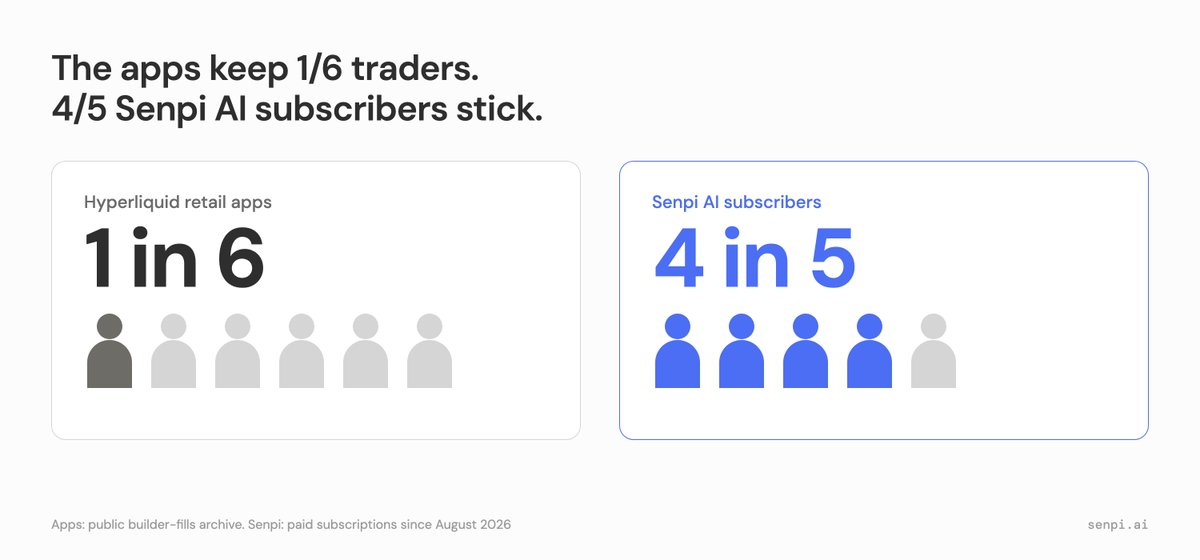
On the apps, half of every month's traders are in their first month, because the other half did not come back. Of the wallets that started between November and June, 16% were still trading three months later. Hyperdash, counting the same population its own way, found one in seven. And the fee is in the mechanism: app traders who finished their first month ahead came back for a second month 40% of the time; the ones who finished behind, 31%. By the fourth month it is 24% against 19%. Push a marginal trader under water in month one and you have lost months two through twelve.
Senpi's numbers run the other way. 77% of our subscribers renew, and 4/5 of subscribers who buy extra AI credits are still with us. Our traders who finish their first month green are still active in month four at a 45% higher rate than those who finish it red. All of that was measured with our fee still on.
V. Who we are building for
The traders who move this market do not pay app fees, and that is the point.
In the Cursor for Trading piece we counted the other side of the venue: on Hyperliquid, traders with no third-party app in the loop do 84% of the non-market-maker volume. App usage falls as accounts get bigger, from nearly half of the smallest accounts to fewer than one in seven of the wallets trading $100M a month or more. The professionals go to the exchange directly, pay its fee, and nothing more.
What they do pay for is intelligence. A QuantConnect seat runs from $888 to $12,912 a year. A Bloomberg terminal is $32,000. Neither takes a cut of your trades. Those are the budgets we compete for, and a desk that already pays exchange fees only was never going to route its execution through a layer that skims every fill. Every basis point of markup was a reason to keep execution exactly where it was.
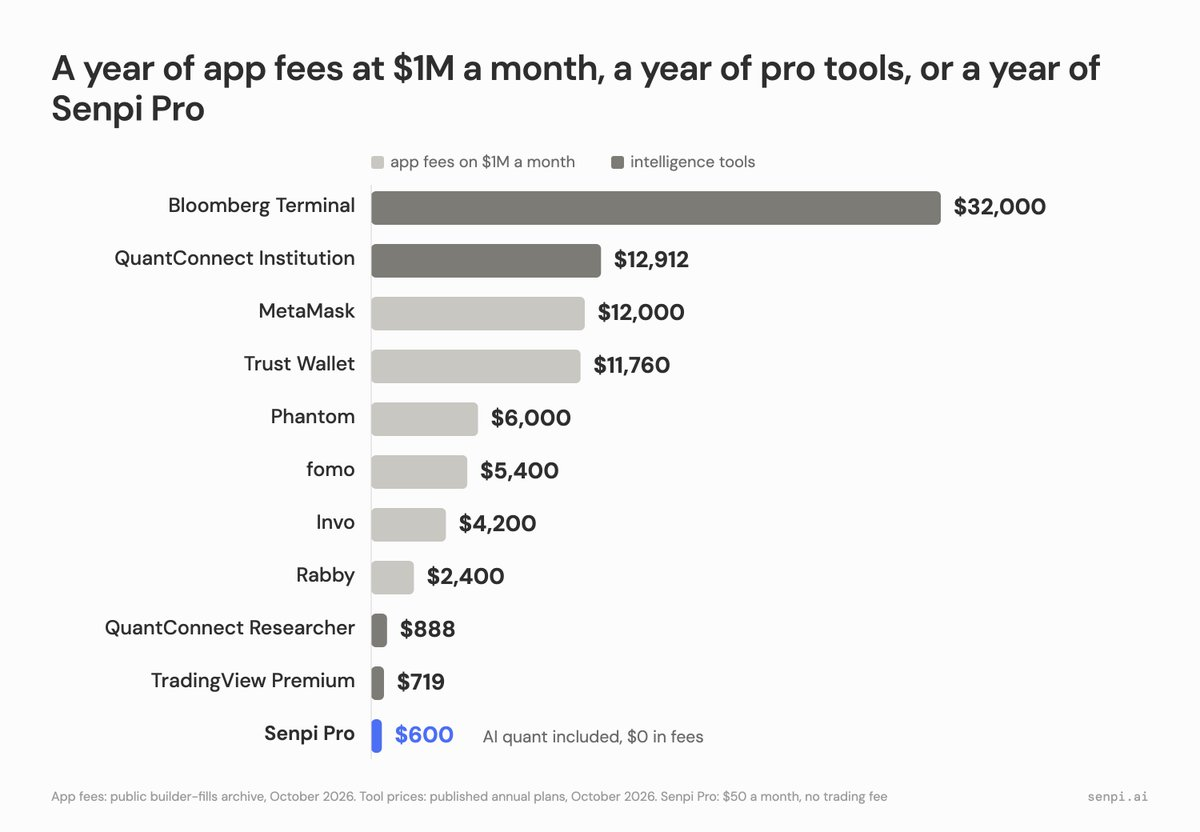
So the apps and Senpi are charging opposite customers. The apps charge the traders who lose. We charge the traders who want to win, for the work that helps them do it. Build for the professionals and everyone wins, because the bar is higher than anything retail has used before, and retail follows the pros.
VI. This is not a SaaS business. It is an inference business.
It would be easy to read this as Senpi becoming a subscription software company. It is not that either.
What people buy from Senpi is AI work: reads of the book, of the whales, of their own fills; strategies written, backtested and run; a harness that watches positions around the clock. That work is metered in inference credits. The plans are the entry ticket and the credit allowance; top-ups are the meter running. The traders who value the work have, in practice, unlimited budget for it, and for most professionals it is the firm's inference budget, not their own.
That is why plans ladder by capacity and never by a cut of a fill. More concurrent strategies, more strategies per billing period, backtesting and simulation, third-party data plugins. You pay for more intelligence and more engineering horsepower, and the price of a trade is Hyperliquid's price. An intelligence layer that taxes every fill is not an intelligence layer. It is another app with a chatbot.
VII. What changes today
- 0% trading fees on every paid Senpi AI plan. Starter, Pro, Advanced and Quant all trade with no Senpi markup, from the first fill after you subscribe.
- The 14 day free trial carries a small Senpi fee, and it goes to zero the moment you subscribe. There is no free plan. The trial is 14 days with AI credit included, so you can run the agent and trade through it before you decide.
- Hyperliquid's own fees still apply. Zero means zero to us. The exchange charges what it charges everyone.
- Our builder code stays on every order. It records volume, not revenue, so nothing about where your trades come from is hidden.
- More credit on the bigger plans. Bonus AI credit starts at the $50 plan and grows with the tier, because the users who run the most strategies are the ones who burn the most inference.
VIII. What you get for the plan
- AI intelligence everywhere you trade. Hyperliquid, Phantom, Axiom, Coinbase, Binance, TradingView and 22 more sites, through the Senpi browser companion.
- Connectors for ChatGPT, Claude, Gemini, Grok, Cursor and Hermes, so your Senpi agent answers inside the AI you already use.
- Whale movements and smart-money divergence on any asset, in seconds.
- Alpha signals, scored and sourced.
- An AI that codes like the pros. Describe a strategy in plain language, backtest it, run it with a harness that holds your stops.
IX. Not a shift. A continuation.
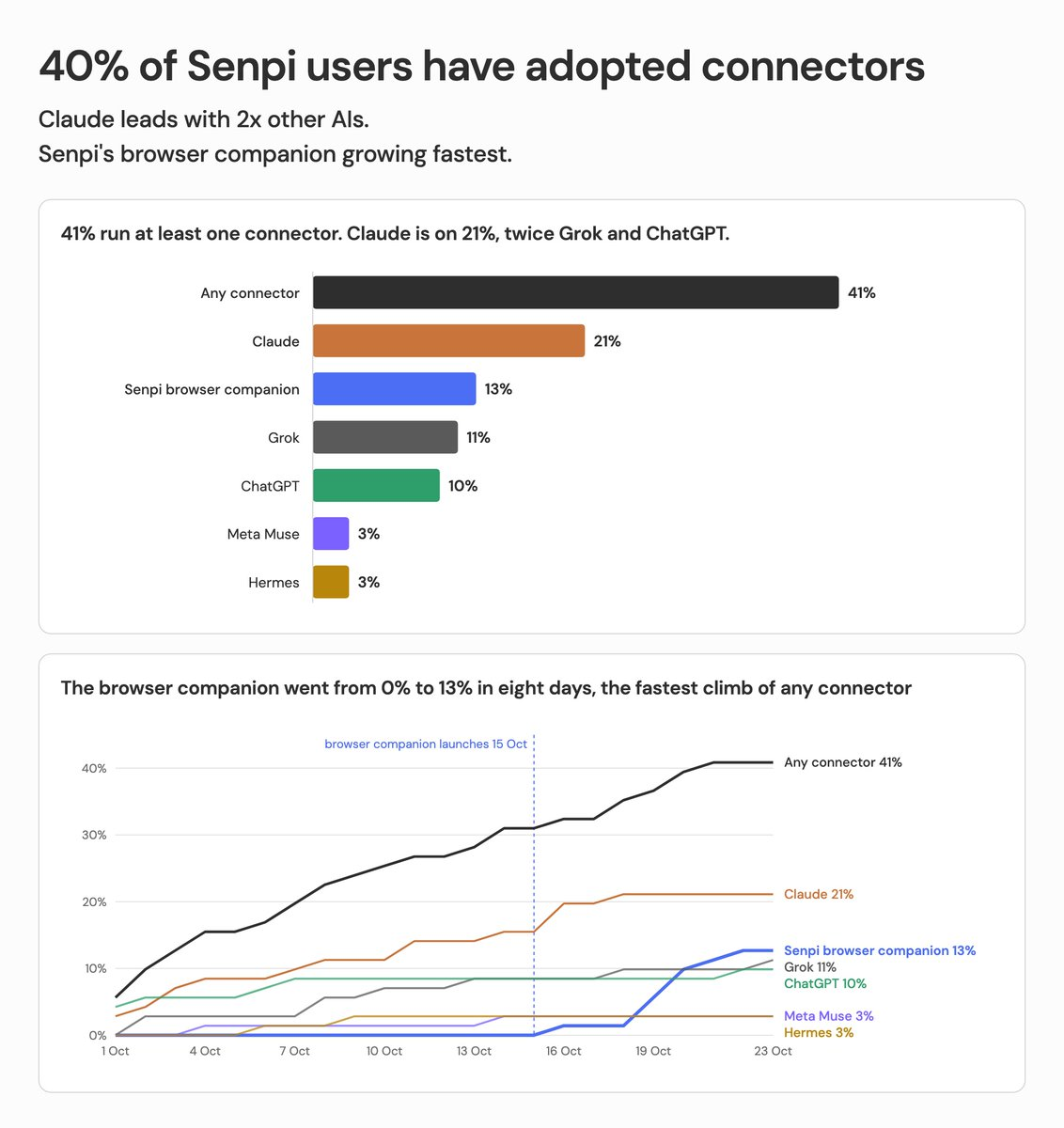
This is where we have been heading for weeks, and it lines up with every product move of the past month: Senpi everywhere. The connectors, the companion, the MCPs, the intelligence layer across the whole venue rather than one more place to click. Among our most active users, four in ten already run Senpi from a connector, Claude leads at twice the next AI, and the browser companion is the fastest-growing surface we have ever shipped.
A fee on every fill was the one thing that still made Senpi look like another app taking a cut. Removing it finishes the move.
A new era
0% trading fees are live now on every paid plan. Start a 14-day trial, and when you subscribe, your Senpi fee goes to zero.
Your AI quant. Now with 0% trading fees.
On the numbers. Senpi figures are the 90 days from 24 July to 22 October 2026, every fill on every Senpi strategy wallet, internal accounts and accounts whose agent was never used in the window excluded; the zero-fee counterfactual re-prices the same trades and does not model any change in behaviour. App fees and app-wallet outcomes are from the public builder-fills archive at stats-data.hyperliquid.xyz, 11 November 2025 to 20 October 2026, with outcomes from an 1,800-wallet sample pulled from the public API, liquidations included. Senpi reads are observations, not investment advice.