
What is whale following on Hyperliquid, and does it work?
How whale following works on Hyperliquid, what the market did after Senpi’s June 2026 whale-versus-crowd call, and how to follow proven wallets with risk control.

Whale following means trading in the direction of the wallets that have made the most money, on the bet that they see something the crowd doesn’t. Hyperliquid makes it possible in a way most exchanges don’t: every position on the exchange is public, so anyone can see what the most profitable wallets hold and how that changes hour by hour.
Does it work? As a signal, sometimes; as a promise, never. Proven wallets can be right on direction and still wrong on timing: in the June 2026 call below they were right on HYPE and wrong on SOL and BTC.
How whale following works on Hyperliquid
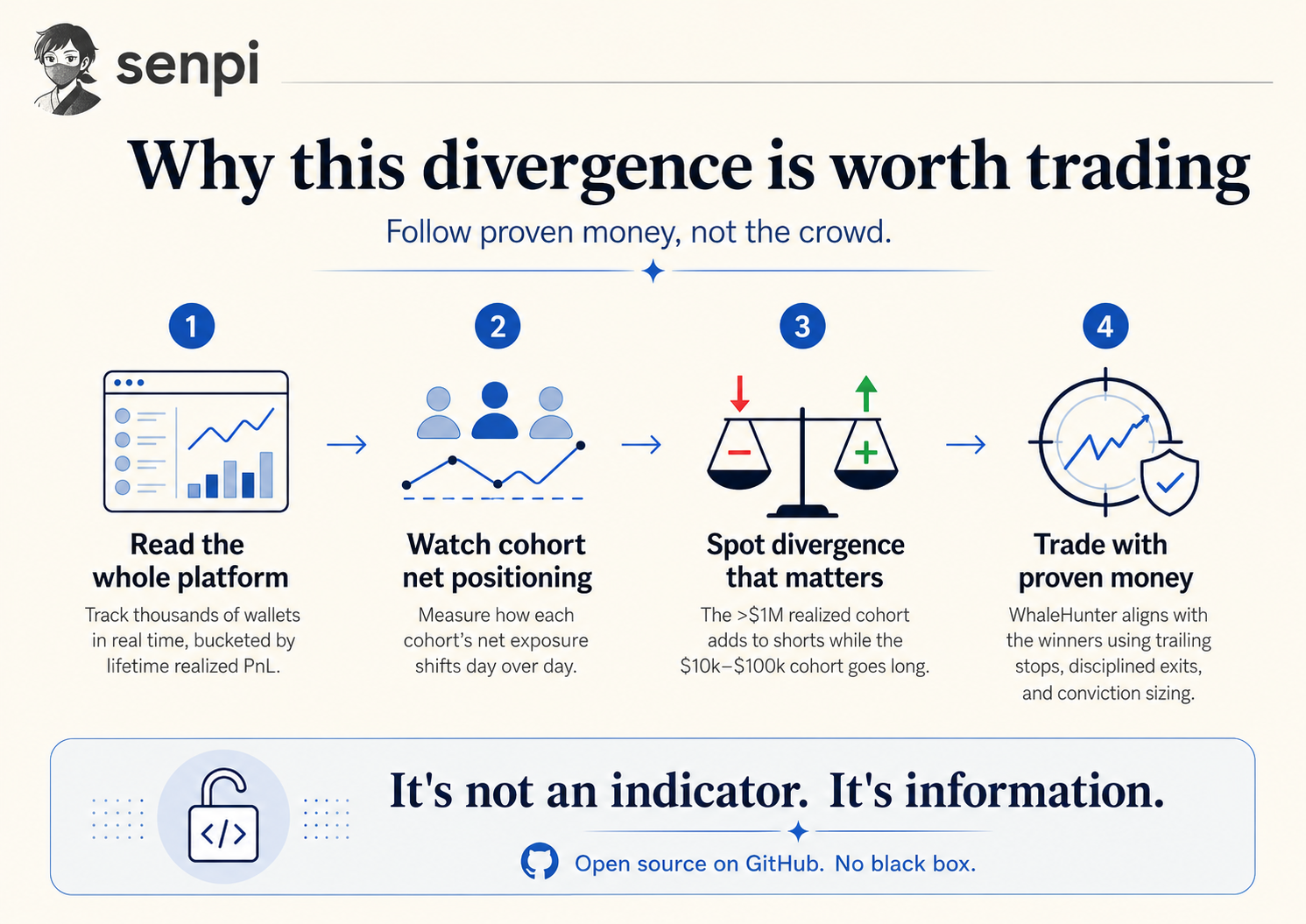
Find the proven wallets. Rank wallets by lifetime realized profit, not by one good week. Senpi’s WhaleHunter strategy counts a wallet as smart money above $1 million realized.
Count heads, not dollars. A long that simply rose in price looks like a whale “adding” if you measure in dollars. Counting how many proven wallets hold a side, one vote each, avoids that.
Watch the change, not the snapshot. A standing short can be a hedge. Several proven wallets newly joining the same side of the same coin is the signal.
Compare with the crowd. When mid-sized profitable wallets ($10,000 to $100,000 realized) lean the other way, the proven money and the crowd have split. That is the setup the June call caught.
The June 2026 call that became WhaleHunter
In mid-June 2026, Senpi’s agent flagged a split on Hyperliquid. HYPE had rallied from $53.28 on June 10 to $73.58 on June 16 (daily closes). Through the rally, the wallets with more than $1 million in realized gains were heavily short and adding to their shorts day after day, while the mid-sized profitable wallets swung from roughly flat to firmly long.
We turned that observation into a strategy, WhaleHunter, and wrote it up on June 23, 2026. Its code is open source.
What the market did after June 23
Here is what happened next on the three markets the call was about. These are market moves from Hyperliquid’s daily closes, not WhaleHunter’s trading results, and past moves don’t predict future ones.
Market | Close, June 23 | 7 days later | 14 days later | 30 days later | Range over 30 days |
|---|---|---|---|---|---|
HYPE | $62.14 | +4.6% | +11.3% | −7.6% | −7.6% to +14.8% |
SOL | $69.64 | +5.7% | +15.6% | +8.9% | −2.8% to +18.3% |
BTC | $62,706 | −6.5% | +1.0% | +3.8% | −6.5% to +6.1% |
Source: Hyperliquid daily candles (UTC closes), June 23 to July 23, 2026. Changes are from the June 23 close; the range is the lowest and highest daily close in those 30 days.
Read as a short call, the result is mixed. By the time the write-up went out, HYPE had already fallen 15.5% from its June 16 close, so the proven wallets had been right early. After June 23, HYPE ended the month 7.6% lower, but only after rising as much as 14.8% first, enough to stop out a short with a tight stop. SOL and BTC finished the month higher. Right on direction for one market, wrong on timing for all three: that is why WhaleHunter trades with stops and sizing rules instead of a conviction bet.
How WhaleHunter works today
WhaleHunter has changed since June. Version 1.3.2 works like this (the rules are public on GitHub):
Counts the wallets with more than $1 million realized on each coin and side, one vote per wallet.
Fires only when one side holds at least 65% of the positioned wallets, at least ten of them, and that side’s headcount grew by two or more since the last read. The first read only sets the baseline.
Bets a little more when the $10,000 to $100,000 crowd leans the other way.
Marks every signal right or wrong an hour later and raises the bar for an asset class that keeps missing.
Runs long and short on separate wallets, with up to 5x leverage and six positions, and leaves every exit to DSL, Senpi’s stop that ratchets up as a trade gains and never loosens.
Why following whales goes wrong
Hedges look like bets. A big short may offset spot holdings or a long elsewhere and says nothing about direction.
Right direction, wrong time. The June HYPE short had to sit through a 14.8% rise before it paid.
Market makers and vaults. Their positions follow inventory, not a view. Filtering by realized profit and counting wallets helps, but not completely.
You arrive late. By the time a move is visible and copied, part of it is gone, and a whale can exit faster than a follower notices.
Survivorship. Leaderboards show who is up now. A wallet with one huge win can sit at the top while being a poor guide.
How to follow whales with risk control
Check the record before the position. Look at how a wallet made its money, not just how much: drawdown, win rate, leverage and how long it has traded. Senpi’s Quant Desk scores any Hyperliquid address on six dimensions.
Follow a group, not a guru. A signal built on many proven wallets is harder to fool than one wallet’s trade.
Size small and set the stop first. Decide the most you can lose before the trade opens; see max drawdown.
Let the stop trail. A trailing stop loss keeps part of a gain when the whales turn out to be early.
Know how copying fails. Read seven ways a copy trade quietly goes wrong.
To try it, open Senpi and ask your agent to set up WhaleHunter, or start by watching the proven-wallet read in Senpi Signals or mirroring a trader you choose, after the agent researches their record. Strategies built from a rule or a template run with DSL on each position; copy strategies carry at most a flat stop. To compare whale trackers, see Hyperdash vs Senpi.
Frequently asked questions
What is whale following in crypto?
Trading in the direction of the wallets that have made the most money. On Hyperliquid every position is public, so you can see what the most profitable wallets hold and follow how their positioning changes.
Does following whales work on Hyperliquid?
As a signal, sometimes; as a guarantee, never. After Senpi’s June 23, 2026 whale-short call, HYPE was 7.6% lower 30 days later but only after rising 14.8% first, while SOL and BTC ended higher. Proven wallets can be right on direction and still wrong on timing.
How can I see what Hyperliquid whales are holding?
Positions are public on Hyperliquid. Trackers such as Hyperdash list large wallets; Senpi Signals groups proven wallets against the crowd for each asset, and Quant Desk scores any address.
What is WhaleHunter?
An open-source Senpi strategy that goes with the wallets that have more than $1 million in realized profit when enough of them newly line up on the same side of a coin, bets more when the smaller crowd leans the other way, and leaves exits to DSL.
Is copying whale trades safe?
No copy trade is safe from loss. Hedges, market makers, late entries and sharp squeezes all hurt followers; size small, set the stop first and follow a group of proven wallets rather than one.